

Stun guns are marketed as non-lethal self-defense tools, but their safety record depends entirely on the person holding them. Knowing how to use a stun gun safely is not just about pressing a button against an attacker; it involves reviewing best The legality and availability of personal security tools in the US, mastering grip and technique, and having a clear post-use plan. Misuse can lead to accidental self-injury or serious legal consequences, even if you never intended to use the device. This guide provides a comprehensive, safety-first approach to owning and operating a stun gun, focusing on legal compliance, operational technique, and responsible handling.
Disclaimer: This article is for educational purposes only. It focuses on safety and legal awareness, not on promoting violence. Always prioritize de-escalation and retreat over confrontation.
Key Takeaways
- A stun gun is only as safe as your understanding of its limitations, including its short range, battery life, and the legal restrictions in your area.
- Proper grip and aiming technique are critical; a fumbled device can easily become a weapon against you.
- You must know your local laws regarding possession, carry, and use, as these vary widely by jurisdiction.
- Regular practice and maintenance—including battery checks and test firing—ensure the device works when you need it most.
- After any use, the priority is to disengage, move to a safe location, call authorities, and seek medical attention if necessary.
The Complete Answer: What “Safe Stun Gun Use” Actually Means

Visual guide illustrating the correct way to hold a stun gun securely with thumb on the safety and support hand stabilizing the device to prevent accidental discharge.
Safety is not a single action but a system. Safe use encompasses three distinct phases: pre-use (legal and physical readiness), during-use (technique and situational awareness), and post-use (disengagement and legal reporting). Failing in any one of these phases can turn a self-defense tool into a liability.
Defining Safe Use Beyond Just “Pulling the Trigger”
Many people assume that safe use begins and ends with the moment of contact. In reality, the most dangerous mistakes happen before and after the trigger is pulled. Pre-use safety involves verifying that you are legally allowed to carry the device in your specific location and that the device is fully charged and functioning. During-use safety requires you to maintain control of the device and your own body. Post-use safety is about disengaging and reporting the incident correctly to avoid legal complications.
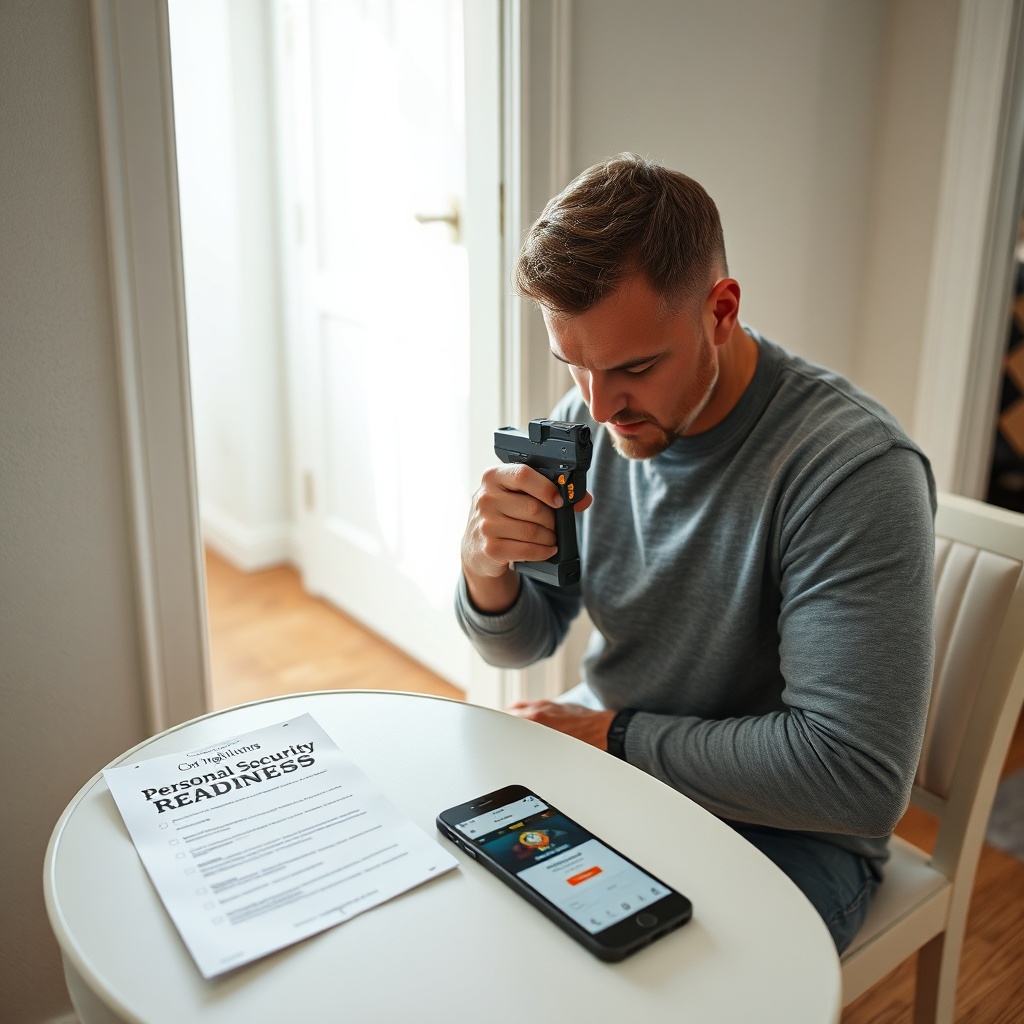
Scene depicting a user verifying battery levels and safety mechanisms while referencing legal guidelines, emphasizing the importance of maintenance and knowledge for safe ownership.
The Core Safety Principles (The “Three C’s”: Control, Contact, and Clearance)
To master how to use a stun gun safely, you need to internalize three core principles.
- Control: This refers to your physical grip and your knowledge of the device’s mechanics. You must know exactly how the safety switch works, how much pressure the trigger requires, and how to hold the device so it cannot be easily grabbed or knocked away.
- Contact: This involves understanding where and for how long to apply the device. The optimal contact points are large muscle groups like the thigh, torso, or shoulder. You should avoid sensitive areas like the eyes, throat, or groin. The typical duration of contact for effective incapacitation is 1 to 3 seconds, after which you should release.
- Clearance: Immediately after delivering the shock, you must create distance. Do not wait to see if the attacker falls; assume the shock worked and retreat. This prevents the attacker from grabbing the device or continuing the fight.
Why Safety Training Is Non-Negotiable
A stun gun is not a “point and click” tool. Under stress, your fine motor skills degrade, and you may fumble with the safety or lose your grip. This is why studying best Self defense techniques 2024 is essential. Building muscle memory through dry-firing and simulated scenarios reduces the risk of fumbling and ensures the device is an extension of your hand, not a foreign object. Incorporating stun gun handling into your broader defensive tactics practice is the only way to ensure safe deployment when adrenaline is high.
Understanding Your Stun Gun: Types, Mechanisms, and Legal Boundaries
Before you can safely use a stun gun, you must understand what you are holding. Different models have different handling characteristics and legal classifications.
The Three Main Types: Contact Stun Guns, Stun Batons, and Stun Flashlights
The type of device you choose significantly impacts how you must handle it.
- Contact Stun Guns: These are compact devices that require direct contact with the target. They are best for close-quarters defense and are highly concealable. However, their short reach means you must be within arm’s length of a threat, which increases the risk of a physical struggle.
- Stun Batons: These provide a longer reach and act as a physical barrier between you and an attacker. They require more space to swing and are less concealable, making them better suited for home defense or for security personnel.
- Stun Flashlights: These combine illumination with a stun function. They are useful for identifying threats at night, but the dual function can sometimes make it harder to quickly activate the stun feature under stress.
Comparison Table: Stun Gun Types at a Glance
| Feature | Contact Stun Gun | Stun Baton | Stun Flashlight |
|---|---|---|---|
| Reach | Very short (arm’s length) | Medium to long | Short to medium |
| Primary Use | Concealed carry, close defense | Creating space, crowd control | Illumination + defense |
| Ease of Concealment | High | Low | Moderate |
| Risk of Accidental Discharge | Moderate (if not holstered) | Low (requires swing) | Low (requires activation) |
| Best For | Everyday carry (EDC) | Home defense, security personnel | Nighttime outdoor use |
How the Electrical Discharge Works (and Why It’s Not Lethal in Normal Use)
Definition: A stun gun is a self-defense device that delivers How Do Stun Guns Work? A Complete Beginner’s Guide to Voltage and Amps directly to a person’s body through contact, temporarily disrupting muscle function.
This electrical discharge works by overwhelming the body’s neuromuscular system, causing involuntary muscle contractions and confusion. It is important to distinguish a stun gun from a taser. A taser uses projectiles (darts) to deliver the shock from a distance, while a stun gun requires direct skin or clothing contact. The current from a stun gun does not penetrate deep into the body; it travels across the surface, which is why it is generally considered non-lethal for healthy adults. However, individuals with heart conditions or pacemakers could be at risk, so you should always be cautious about who you use it on.
Legal Restrictions: What You Must Know Before You Carry
Quick Answer: Stun gun laws are not universal. Some states and municipalities require a permit, while others prohibit carry in specific locations like schools, government buildings, and airports. You must verify your local laws before purchasing or carrying a stun gun.
Legal compliance is a critical component of safe use. The legality of stun guns varies significantly by jurisdiction. Some areas treat them like firearms and require a license, while others have no specific restrictions on possession but heavily regulate where you can carry them. Age restrictions also vary. Before you buy a stun gun, you must research the laws in your specific state, county, and city. Pay particular attention to “no-go” zones where carrying a weapon is prohibited, regardless of your permit.
Step-by-Step: How to Safely Operate a Stun Gun in a High-Stress Situation
Knowing how to use a stun gun safely in a real-world scenario requires a specific sequence of actions. This step-by-step guide will help you build a reliable response.
Step 1: Pre-Use Check (The “Five-Second” Safety Check)
Before you even consider carrying the device, you must ensure it is ready. This check should take less than five seconds. First, confirm the safety is off (if your model has one) and the device is charged. Check the battery indicator light. If you are unsure, test-fire the device into the air, away from your body, to confirm it produces a spark. Finally, ensure your grip is firm, with your thumb resting on the activation button and your fingers wrapped securely around the handle.
Step 2: Adopt a Defensive Stance
Your stance is your foundation. Place your non-dominant hand in a protective position, palm out, to block or deflect incoming attacks. Keep your dominant hand with the stun gun at waist level, ready to thrust forward. Maintain a slight crouch to improve your balance and stability. This posture allows you to react quickly while keeping your most important tool out of the attacker’s immediate reach.
Step 3: Aim for Large Muscle Groups
Do not aim for the neck, head, or groin. These are sensitive areas and are often moving targets. Instead, target large muscle groups like the thigh, torso, or shoulder. Press the stun gun firmly against the target’s clothing or skin; do not just tap it. Hold the trigger for 1–3 seconds, then release. The duration of contact matters more than the initial shock.
Step 4: Disengage and Create Distance
After the shock, immediately step back or push the attacker away. Do not wait to see the effect. Assume it worked and retreat to a safe area. Keep the stun gun in front of you as a barrier while you back away. Your goal is to create a gap between you and the threat, not to continue the confrontation.
Step 5: Post-Use Protocol
Once you have created distance, move to a well-lit, populated area or call 911. Do not pursue the attacker. If you used the device, you should report the incident to the police and keep the stun gun for evidence. Seek medical attention if you or the attacker sustained injuries from the fall or struggle. Never linger at the scene.
Common Mistakes That Compromise Safety (and How to Avoid Them)
Even with the best intentions, common mistakes can compromise your safety. Here are seven critical errors to avoid.
Mistake #1: Holding the Stun Gun Too Close to Your Own Body
The risk of accidental self-shock is real, especially if the device has exposed contacts. If you hold it too close to your body or fumble with it, you could shock yourself or your clothing. Use a holster with a protective flap and always keep the contact points pointed away from your body.
Mistake #2: Relying on the Stun Gun as a “Magic Bullet”
A stun gun is not guaranteed to stop a determined attacker, especially if they are under the influence of drugs or alcohol or wearing thick clothing. Relying solely on the device can lead to a false sense of security. Combine the stun gun with verbal commands, escape tactics, and best Stun Guns vs. Pepper Spray: Choosing the Right Self-Defense Tool.
Mistake #3: Neglecting Battery Maintenance
A dead battery is a useless tool. The worst time to discover a dead battery is during an attack. Set a monthly reminder to check and recharge the device, and test-fire it once a month to ensure it is functioning correctly.
Mistake #4: Ignoring Legal “No-Go” Zones
Carrying a stun gun in a prohibited area—such as a school, courthouse, or airport—can lead to criminal charges even if you never use it. Review your local laws annually and always check for signage before entering a building.
Mistake #5: Forgetting to Practice Drawing and Deploying
Simply owning a stun gun is not enough. If you have never practiced drawing it from a holster, you will likely fumble under stress. Practice drawing, activating the safety, and targeting a fixed point in a safe environment.
Mistake #6: Using the Wrong Contact Duration
Holding the trigger for too long can cause unnecessary harm, while a mere tap may not be effective. Aim for the 1-3 second window. This duration is generally sufficient to cause muscle incapacitation without escalating the situation unnecessarily.
Mistake #7: Neglecting Storage and Child Safety
Stun guns must be stored securely, out of reach of children and unauthorized persons. A stun gun left on a counter is a hazard. Use a locked drawer or a secure safe. This is a fundamental part of stun gun safety guidelines.
Training and Practice: Building Muscle Memory for Safe Deployment
Safe deployment is a skill, and skills require practice. You cannot expect to use a stun gun effectively under stress if you have never practiced with it.
Why Dry-Firing Practice Is Essential
Dry-firing is the practice of operating your stun gun without a battery or with the safety engaged. Practice drawing from a holster, activating the safety, and targeting a fixed point like a pillow. Perform this in a safe, empty room to avoid accidental discharge. Repeating this motion 20–30 times daily builds the muscle memory needed to operate the device without thinking.
Simulating Stress Scenarios
Practice with a partner using padded gloves or a dummy to simulate an attacker. Focus on maintaining your grip while moving backward and shouting commands. This type of scenario-based training helps you prepare for the chaos of a real encounter.
Maintenance Schedule for Optimal Safety
A regular maintenance schedule ensures your device is always ready.
- Monthly: Test-fire (in a safe direction), check the battery, and clean the contacts.
- Quarterly: Review local laws and update your carry strategy.
- Annually: Replace the battery (if rechargeable, check for degradation) and consider a refresher course.
Frequently Asked Questions (FAQ)
Can I accidentally shock myself with a stun gun?
Yes, you can. If you touch the contact points while the device is active or if you hold it too close to your body, you may shock yourself. Always keep the contacts pointed away from your body and use a holster with a protective flap.
How long should I hold the stun gun against an attacker?
Typically, 1–3 seconds is sufficient to cause muscle incapacitation. The exact duration depends on the model and the attacker’s resistance. Always disengage after the shock and create distance.
Is a stun gun legal to carry in all states?
No, laws vary significantly. Some states require a permit, while others prohibit carry in certain locations like schools or government buildings. Check your local laws before purchasing or carrying a stun gun.
What should I do if I use my stun gun in self-defense?
Immediately move to a safe location, call 911, and report the incident. Do not flee the scene without reporting. Keep the stun gun and any evidence for law enforcement.
Can a stun gun be used on someone with a pacemaker or heart condition?
The electrical current can potentially interfere with medical devices like pacemakers. It is strongly advised to avoid using a stun gun on anyone with a known heart condition. If this occurs, seek medical attention immediately.
Conclusion
Understanding how to use a stun gun safely requires a commitment to more than just owning the device. It demands legal compliance, proper technique, regular practice, and a clear post-use protocol. A stun gun is a tool for creating an escape window, not a weapon to win a fight. Always prioritize de-escalation and retreat over confrontation.
Invest time in training with your specific device and review your local laws before you carry it. The goal is not to be the hero of a confrontation, but to be the person who gets home safely.

