

Self defense for runners is not martial arts for the mat — it’s a practical, movement-friendly system built around one goal: getting away safely. When you’re mid-stride, breathing hard, and focused on pace, your body is in a vulnerable position. But you also have something most people don’t — momentum, speed, and the ability to escape. This guide covers awareness, prevention, and a handful of simple response tactics that fit naturally into a run.
Quick Answer: Self defense for runners focuses on escape, not combat. The core skills are situational awareness, creating distance, and using simple strikes to break free and run.
Key Takeaways
- Self defense for runners is primarily about escape and deterrence, not prolonged combat.
- Situational awareness is the single most effective defensive tool — it prevents most threats from escalating.
- Simple, repeatable techniques (e.g., palm strike, elbow, kick to the knee) are more useful than complex martial arts moves mid-run.
- Your running gear — water bottle, keys, even a jacket — can serve as improvised defensive tools.
- The goal is to create distance and get to safety, not to “win” a fight.
Self Defense for Runners: The Complete Answer

Mastering environmental awareness is the first step in practical self defense for runners seeking to stay safe during outdoor workouts.
The Core Definition
Definition: Self-defense for runners is a practical, movement-friendly system of awareness, prevention, and rapid escape tactics designed specifically for the context of running.
It prioritizes maintaining momentum and creating space over grappling or ground fighting. The techniques are chosen for their simplicity and for how well they work while your body is already in motion.
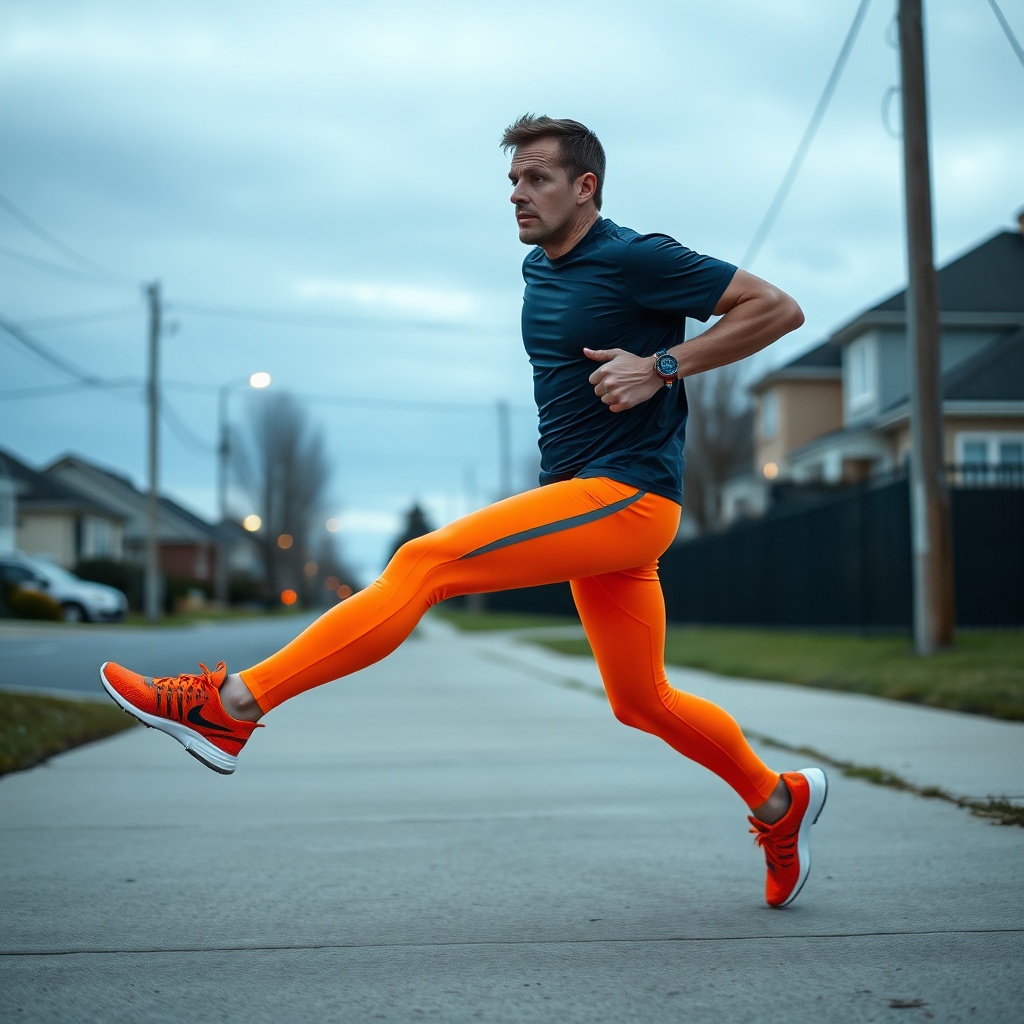
Using controlled strides and simple barriers helps runners maintain momentum while applying proven self defense for runners strategies to create safe distance.
The Three Pillars: Awareness, Avoidance, Action
Awareness means reading your environment and identifying potential threats early. This is the foundation — most dangerous situations can be defused before they begin if you notice them soon enough. Avoidance is the second pillar. It involves changing your route, timing, or behavior to remove yourself from danger before it arrives. The best self-defense is the fight you never have to start. Action is the last resort. When a threat is immediate, you use minimal-force strikes and escapes to break free and flee. Action is not about fighting back for long — it’s about creating the shortest possible window to get away.
The Mindset Shift
The most important change is mental. Many runners think “I hope nothing happens.” The shift is to “I have a plan if something happens.” By exploring Empowering Yourself: The Use of Non-Lethal Self-Defense Tech, runners who view themselves as capable of defending their own space are less likely to be targeted in the first place, and far more likely to respond effectively if they are.
The Runner’s Unique Threat Profile (Why Runners Are Targets)
Situational Awareness on the Move
While running, it’s easy to fall into tunnel vision — a narrow focus on pace, distance, or music that blocks out everything else. To stay aware, use a simple three-point check: scan front, then sides, then behind, at regular intervals. This keeps your eyes moving without breaking your cadence.
Definition: Situational awareness is the practice of actively noticing and interpreting what’s happening around you — people, vehicles, sounds, and potential escape routes — so you can spot a threat before it reaches you.
Listen for approaching footsteps, changes in vehicle behavior, or sounds that don’t match your environment. These auditory cues can alert you to an anomaly before you see it.
The “Predator” Decision-Making Process
Attackers select targets based on signs of distraction, isolation, and vulnerability. A runner wearing headphones, looking at the ground, and breathing heavily can inadvertently signal all three. The opposite signals — quick eye contact, confident posture, and visible awareness — tell a potential attacker that you are not an easy target.
High-Risk Scenarios for Runners
Certain situations carry more risk. Early morning and late evening runs in low-traffic areas reduce the number of potential witnesses. Trail running often limits visibility and escape routes. Running the same route at the same time every day makes it easy for someone to observe and anticipate your movements. Recognizing these scenarios is the first step in running route risk assessment.
Practical Self-Defense Techniques for Runners (No Gym Required)
Here are seven practical escape moves. Each one is simple enough to remember mid-run and designed to create a window for you to get away.
Strike and Escape: The “Run-and-Strike” Principle
The philosophy behind these moves is simple: a quick, effective strike is used solely to create a window for escape — not to win a fight. You strike, then you run. Move 1: Open-palm strike to the nose or chin. Use the heel of your palm, not your fingers. Drive it upward and forward toward the attacker’s nose or chin. This causes an involuntary flinch and can momentarily stun them, giving you space to turn and run. Move 2: Elbow to the jaw. If the attacker is close, bring your elbow up and across into their jaw or temple. This is a compact strike that works well at close range and doesn’t require a big wind-up. Move 3: Knee to the thigh or groin. A sharp knee to the thigh can cause a muscle spasm, while a knee to the groin is highly effective at creating immediate distance. Both are quick and can be done without losing your balance. Move 4: Heel kick to the shin. If the attacker is in front of you, a downward heel kick to their shin can break their stance and cause them to stumble. This is especially useful when you’re already moving forward.
Quick Answer: The most effective self-defense moves for runners are simple ones you can do without stopping your stride — an open-palm strike to the nose, an elbow to the jaw, or a heel kick to the shin. Each is designed to create a window to escape.
Defensive Maneuvers While Maintaining Pace
Move 5: Shoulder drop and spin. If someone grabs your arm or shoulder from behind, drop your shoulder and pivot your body away from the grab. This uses your momentum to slip their grip and reorient you toward an escape route. Move 6: Wrist grab release. If an attacker grabs your wrist, do not try to pull straight back. Instead, rotate your wrist toward their thumb — the weakest part of their grip — and pull away while continuing your stride. This is a quick, natural motion that breaks free without a struggle.
Using Your Running Gear as a Defensive Tool
Move 7: Improvised gear strike. Your running gear can become a non-lethal self-defense tool. A water bottle held by the base can be used as a striking or blocking object. Keys held between your fingers can provide a focused jab. A jacket or moisture-wicking top can be used as a distraction — wrap it around an attacker’s arm or toss it toward their face to create a split-second opening. These are personal safety gear for runners in a practical sense, much like the 10 Best recommendations for jogging safety, meaning you already carry them, so you just need to know how to use them.
The Pre-Run Routine: Prevention and Deterrence
Route Planning and Environmental Scanning
Choose routes with natural escape options, good lighting, and regular human traffic. Before you head out, map safe havens along your path — stores, police stations, or well-lit areas where you can get help quickly. One useful strategy is the “reverse route”: running your planned route in reverse unpredictably makes it harder for someone to anticipate where you’ll be.
The “Runner’s Ready” Stance and Body Language
Your body language is a deterrent. Keep your head up, hands loose but ready, and eyes scanning. The “runner’s ready” stance is a relaxed but alert posture that lets you transition quickly into a defensive position if needed. If you notice a potential threat, acknowledge it without escalating — a firm nod or a clear “I see you” tells the person you are aware of them.
Technology and Communication Checkpoints
Share your route with a friend or family member using a tracking app. Set check-in times and notifications so someone knows if you’re late. Carry your phone with a quick-dial emergency function already configured. A personal alarm is also worth considering — it can draw attention and startle an attacker. When choosing one, look for a model with a loud siren and a simple activation mechanism you can reach while running.
Responding to an Attack: A Step-by-Step Protocol
Step 1: Assess and De-escalate
Quickly evaluate the threat. Is it a verbal confrontation, an attempted grab, or a full assault? Use verbal de-escalation techniques for joggers — say something firm like “Back off, I have a phone and I’m calling emergency services” — while preparing to move. Trust your instincts. If something feels wrong, act early rather than waiting to be sure.
Step 2: Create Distance
The first physical response should be to create space, not to engage. Use a “shove and step back” motion — push the attacker with your palm while shifting your weight backward. If the attacker is too close, use a quick, sharp elbow or knee strike to force them to release.
Step 3: Strike and Disengage
Target vulnerable areas: eyes, throat, nose, groin, and knees. Execute one decisive strike, then immediately turn and run. Do not chase or continue fighting. The goal is to break contact and get to safety — not to subdue the attacker.
Step 4: Escape and Report
Run toward a safe, populated area or a known safe haven. Call your local emergency number as soon as you are safe. Report the incident to law enforcement and document details: time, location, and a description of the attacker. This is also important for the legal aspects of self-defense for runners — having a clear record of what happened can matter later.
Quick Answer: If someone grabs you while running, strike a vulnerable area once, then immediately turn and run toward a safe, populated place. Do not try to wrestle free or continue the fight.
Comparing Self-Defense Training Options for Runners
Comparison Table: Running-Specific vs. General Self-Defense Classes
| Feature | Running-Specific Self-Defense | General Self-Defense (Krav Maga, BJJ, etc.) |
|---|---|---|
| Focus | Escape and maintain momentum | Ground control and sustained combat |
| Physical demand | Integrates with running motion | Often requires stationary stances |
| Learning curve | Simple, repeatable techniques | Complex techniques requiring practice |
| Best for | Runners who want quick, practical skills | Individuals seeking comprehensive self-defense |
This table is a general comparison based on typical training philosophies. Specific curricula vary by instructor and school.
Choosing the Right Training for Your Needs
When evaluating a self-defense class, consider how it aligns with Top Martial Arts Trends to Watch in 2024, and ask whether it covers running-specific scenarios and how much time it spends on ground defense — which is less relevant for runners who want to stay on their feet. The value of practicing a few techniques repeatedly cannot be overstated. A single palm strike and a wrist grab release, drilled until they feel automatic, are worth more than a dozen moves you’ve only seen once. You can also incorporate defense drills into your regular running routine by practicing a strike-and-run sequence on a safe track.
FAQ
Q1: What is the best self-defense technique for runners?
The best technique is the one that creates immediate distance and allows you to escape. A palm strike to the nose or an elbow to the jaw are highly effective, simple strikes that can be executed while maintaining momentum. The goal is not to fight but to break free and run.
Q2: Should runners carry pepper spray?
Regarding Stun Guns vs. Pepper Spray: Choosing the Right Self-Defense, pepper spray can be an effective deterrent, but it requires proper training and awareness of local laws. If you choose to carry it, practice accessing it quickly and understand your jurisdiction’s regulations. It should be seen as a supplement to, not a replacement for, situational awareness.
Q3: How can runners stay safe on trails?
Trail runners should prioritize route familiarity, run with a partner when possible, and avoid using headphones that block ambient sound. Carry a phone and a personal alarm, and tell someone your route and expected return time. Be particularly cautious in areas with limited visibility or sparse cell coverage.
Q4: What should I do if someone tries to grab me while running?
Do not try to wrestle free. Instead, use a decisive strike to a vulnerable area (e.g., a palm strike to the chin, a knee to the thigh) to break the grip, then immediately run toward a safe location. The key is to disengage and escape, not to continue the fight.
Q5: Is running self-defense training worth it?
Yes — even a few hours of practice can dramatically improve your ability to respond to a real threat. Running-specific self-defense focuses on simple, repeatable techniques that align with your natural movement, making them easier to recall under stress. It also builds mental confidence, which itself is a deterrent. Related reading: [10 Best Self-Defense Weapons for Runners and Joggers](https://cheetahstunguns.com/2026/07/09/10-best-self-defense-weapons-for-runners-and-joggers/) · [Stun Guns vs. Pepper Spray: Choosing the Right Self-Def](https://cheetahstunguns.com/2023/10/16/stun-guns-vs-pepper-spray-choosing-the-right-self-defense-tool/) · [Empowering Yourself: The Use of Non-Lethal Self-Defense](https://cheetahstunguns.com/2025/12/14/empowering-yourself-the-use-of-non-lethal-self-defense-techniques/) · [Top Martial Arts Trends to Watch in 2024](https://cheetahstunguns.com/2024/03/23/top-martial-arts-trends-to-watch-in-2024/)
Conclusion
Self defense for runners is a proactive, practical discipline built on awareness, avoidance, and decisive escape. The most important tool is your own mindset — being present, prepared, and willing to act. Integrate a few basic techniques into your routine and review your safety habits regularly. No single technique is perfect; the best defense is a prepared, confident, and aware runner.

