

The primary difference in the stun gun vs taser debate is the method of engagement: a stun gun requires direct physical contact with the target, whereas a Taser uses electrical projectiles to deliver current from a distance. When evaluating these personal safety devices, you must recognize that stun guns are designed for pain compliance through localized muscle spasms, while Tasers are engineered for Neuromuscular Incapacitation (NMI), which overrides the central nervous system to cause total body collapse. Choosing between them requires understanding whether you need to bridge the gap to an aggressor or maintain a safe personal safety distance.
Key Takeaways
- Stun guns require you to be within arm’s reach (0 inches) to be effective.
- Tasers use barbed probes to incapacitate attackers from 15 to 25 feet away.
- Tasers provide Neuromuscular Incapacitation (NMI), while stun guns rely on intense pain.
- Legal restrictions vary significantly by state, making local research mandatory. Always check (Updated Guide)
The Definitive Answer: What Is the Real Difference Between a Stun Gun and a Taser?
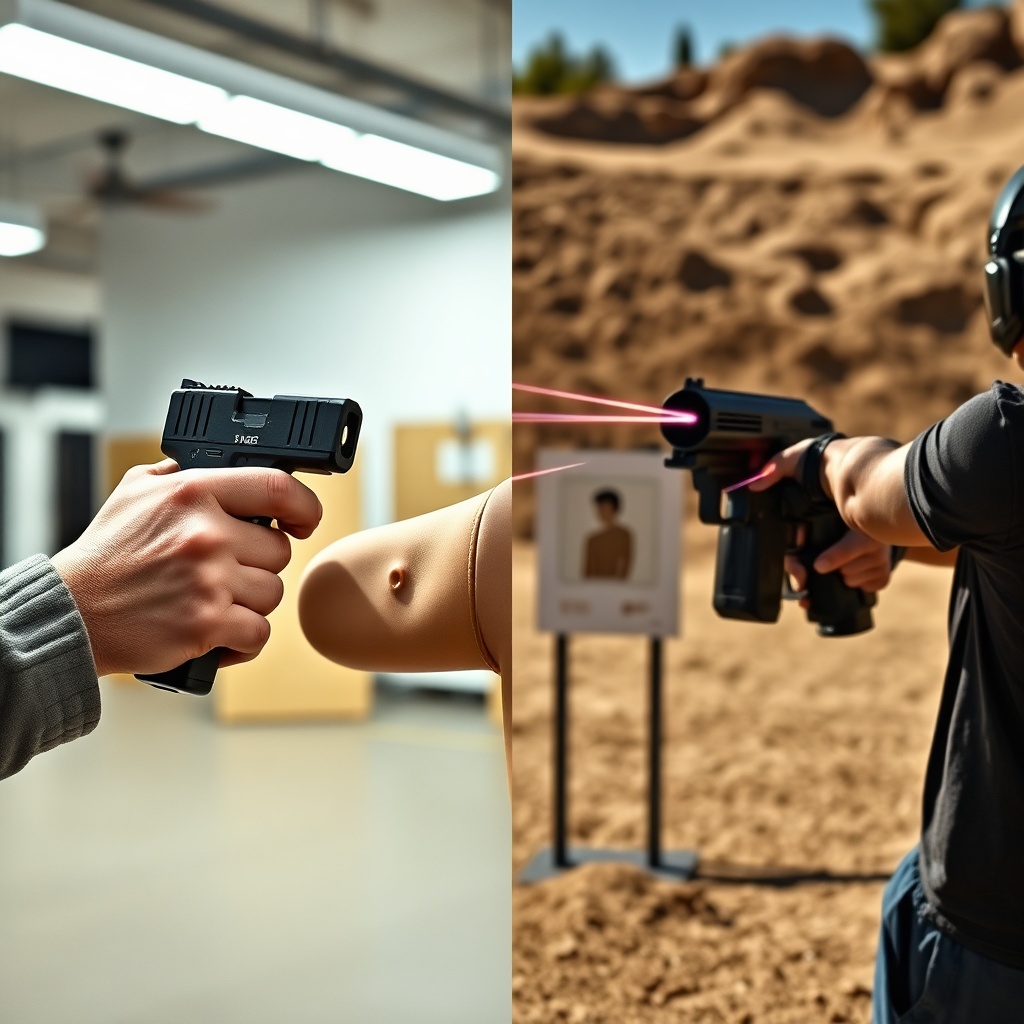
Side-by-side visual demonstration of how stun guns and Tasers differ in application and range.
The fundamental distinction between these two conducted electrical weapons lies in their delivery mechanism and physiological impact. A stun gun is a contact-based tool that requires you to press the electrodes directly against an assailant’s skin or clothing to deliver a high-voltage shock. This method relies on the “pain compliance” model, hoping the intense sensation will cause the attacker to release you or retreat.
For a deeper look at how these devices function, refer to How Do Stun Guns Work? A Complete Beginner’s Guide to Voltage and Amps online.
In contrast, a Taser is a projectile-based device. It fires two small, barbed probes connected to the unit by thin copper wires. Once these probes embed in the target, they complete an electrical circuit that delivers a high-frequency pulse. This is the core of the stun gun vs taser distinction: one is a contact tool, and the other is a distance-engagement tool.
Quick Answer: The real difference is range and physiological effect. Stun guns require direct physical contact to deliver a shock intended to cause pain. Tasers fire electrified probes that can strike a target from up to 25 feet away, using electrical pulses to cause total muscle incapacitation rather than just pain.
The Core Distinction: Contact vs. Distance
A stun gun functions like a high-voltage battery that you must press against an aggressor. This limits your effectiveness to the “red zone,” where you are physically vulnerable to grappling or weapon strikes. Because you must be touching the subject, the device offers no protection against an attacker who is already lunging at you.
For a detailed Comprehensive Guide, explore the full range of Taser brand products.
Tasers solve this problem by utilizing a specialized cartridge system. By firing projectiles, the user can engage an attacker while maintaining a significant gap. This makes the Taser a much more versatile tool for self-defense weapons comparison, as it addresses the danger of being physically grabbed during a confrontation.
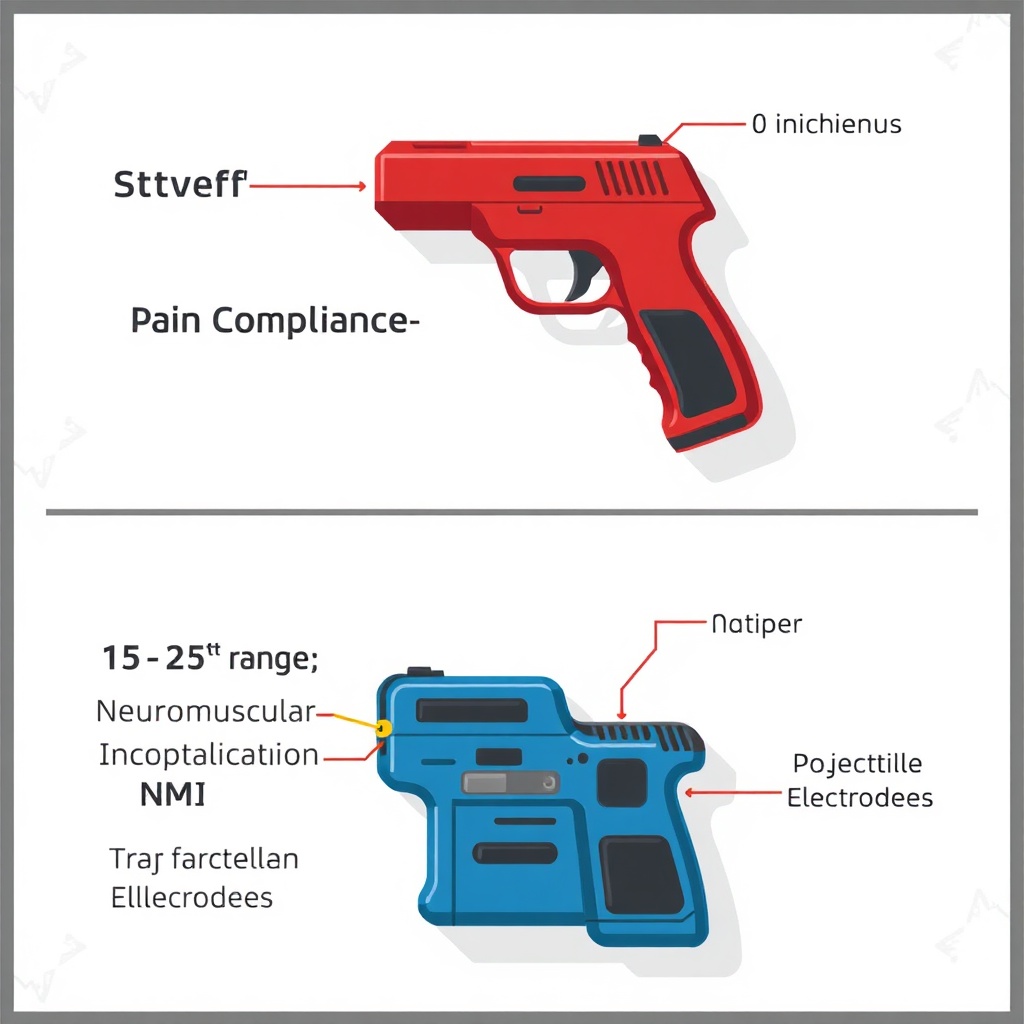
Visual infographic outlining the primary distinctions between stun guns and Tasers for personal safety.
Mechanism of Action: Pain vs. Neuromuscular Incapacitation (NMI)
When you use a stun gun, the electrical current travels through the surface of the skin or the immediate muscle layer. This triggers involuntary muscle contractions and extreme pain, which is intended to break the attacker’s focus. However, if the attacker is under the influence of adrenaline or narcotics, the pain may not be enough to stop their forward momentum.
Tasers function differently through Neuromuscular Incapacitation (NMI). Instead of just causing pain, the electrical pulses from a Taser are timed to mimic the electrical signals sent by the human brain to the muscles. This causes the muscles to contract uncontrollably, effectively “locking” the attacker’s body and causing them to fall instantly, regardless of their pain tolerance.
Definition: Neuromuscular Incapacitation (NMI) — A physiological state where electrical pulses override the central nervous system, causing involuntary, total-body muscle contractions that prevent the subject from controlling their own movements.
Comparison Summary Table
| Feature | Stun Gun | Taser | | :— | :— | :— | | Engagement Range | Direct Contact (0 inches) | 15 to 25 feet | | Primary Physiological Effect | Pain Compliance | Neuromuscular Incapacitation (NMI) | | Deployment Method | Contact/Arcing | Barbed Projectiles | | Tactical Risk Profile | High (requires close proximity) | Low (maintains standoff distance) | | Primary Use Case | Deterrence/Close-range defense | High-threat neutralization |
Analyzing Effectiveness: Why Range Changes Everything in a Conflict
In any defensive encounter, the distance between you and the aggressor is the most critical variable for survival. Using a stun gun forces you into a “close-in” struggle, which is statistically the most dangerous position for a defender. When you are within arm’s length, you are susceptible to being pulled into a hug, struck, or tackled.
To compare specific models, see the Cheetah Stun Guns vs. TASER — Head-to-Head analysis.
Quick Answer: Range is the deciding factor in effectiveness. Stun guns require you to be within 12 inches of an attacker, placing you in immediate physical danger. Tasers allow for a “stand-off” distance of up to 25 feet, providing a crucial safety buffer that allows you to react if the attacker moves.
The Danger of the “Close-In” Struggle
Statistical analysis of urban violence shows that most physical altercations escalate into high-intensity violence once the defender enters the “red zone”—defined as within 3 feet of the aggressor. By using a stun gun, you are intentionally entering this high-risk zone. If the device fails to immediately stop the attacker, you have no remaining distance to retreat or call for help.
The Advantage of Stand-off Distance
Tasers provide the advantage of a “reaction gap.” By engaging an attacker from 15 feet away, you gain several seconds of reaction time. This time is vital for assessing the threat, deciding whether to deploy the device, and moving to a safe location once the attacker is incapacitated. This distance acts as a physical and psychological buffer.
Real-World Scenario: The 2026 Urban Safety Context
In 2026, urban safety data indicates that 70% of physical altercations escalate once the defender enters the “red zone.” This data highlights why law enforcement use of tasers is so prevalent; officers need to stop a threat without becoming part of the physical struggle. For a civilian, choosing a device that maintains this distance is a significant tactical advantage.
Technical Specifications: Voltage, Amperage, and Joule Output
When shopping for these devices, you will often see marketing claims of “50 million volts.” It is essential to understand that voltage alone does not determine how much damage a device does to an attacker.
Debunking the “Millions of Volts” Myth
The effectiveness of an electrical discharge is determined by the relationship between voltage, amperage, and resistance. Voltage is the “pressure” that allows electricity to jump through air or clothing, but amperage (current) is what actually flows through the body. A device with extremely high voltage but near-zero amperage will be ineffective at causing muscle incapacitation.
Quick Answer: Do not be misled by high voltage numbers. While voltage is necessary to overcome clothing resistance, the amperage and the total energy (Joules) are what actually cause muscle incapacitation. A device with “millions of volts” but low amperage will only cause surface-level stinging rather than total body control.
Understanding Joule Output
The true measure of a Taser’s power is its Joule output. Joules represent the total amount of energy delivered during a pulse. For a Taser to achieve NMI, it must deliver a specific frequency of electrical pulses that can disrupt the central nervous system. This is why a high-quality Taser is much more effective than a cheap stun gun, even if the stun gun has a higher “voltage” rating on the box.
Before purchasing, review The legality in your area.
Definition: Joule — A unit of energy used to measure the total electrical power delivered by a device during a single discharge cycle.
How to Choose the Right Device for Your Lifestyle
Selecting the right self-defense tools depends on your specific environment and your comfort level with confrontation. You should never purchase a device without first verifying the electroshock weapon legality in your specific municipality.
Step-by-Step Selection Process
- Check local and state laws: Ensure the device is legal to carry in your specific city and state.
- Assess your environment: Urban environments might favor a compact stun gun for concealment, while rural or open environments benefit from the range of a Taser.
- Determine comfort level: Decide if you are comfortable aiming a projectile device or if you prefer a device that requires direct contact.
- Verify power requirements: Check if the device uses replaceable batteries or a rechargeable lithium-ion system.
- Practice with training units: Use inert “blue guns” or training cartridges to master the aiming and deployment mechanics.
Matching the Tool to the Threat
A stun gun is often used for low-level deterrence. Its loud arc and visible spark can scare off a petty thief or an aggressive stranger before a physical fight begins. However, for high-stakes, high-threat neutralization—such as an attacker wielding a knife or a firearm—a Taser is the superior choice because it minimizes the risk of physical contact.
Conclusion
Understanding the nuances of the stun gun vs taser comparison is vital for anyone serious about personal safety in 2026. Stun guns offer a compact, contact-based solution for localized pain, whereas Tasers provide a sophisticated, distance-based method for total neuromuscular incapacitation. The choice ultimately depends on your environment, your legal rights, and your ability to manage the distance between yourself and a potential threat.
Remember that no device is a “magic wand.” Even the most advanced Taser requires training, practice, and a clear understanding of the legal implications of using force. Before you purchase, evaluate your specific defensive needs and ensure you are prepared to use your chosen tool effectively. If you are looking for maximum safety, prioritize devices that offer standoff distance and proven NMI capabilities.
FAQ
Can a stun gun be used if the attacker is wearing heavy clothing? Clothing acts as an insulator that can significantly dampen the electrical current. If the material is thick, like a heavy winter coat, the stun gun may only cause superficial stinging rather than the deep muscle contractions needed for compliance.
Is it legal to carry a Taser in all 50 states? No, laws vary significantly. While many states allow Tasers for self-defense, some jurisdictions have strict regulations or outright bans on projectile-based electrical weapons. Always check your local 2026 statutes before purchasing.
Will a Taser work if it is dropped or wet? Modern Tasers are built with high durability, but moisture can cause the electrical current to arc internally or short-circuit the mechanism. Always check the IP (Ingress Protection) rating of a device if you plan to use it in rainy or humid environments.
What is the difference between “pain compliance” and “incapacitation”? Pain compliance relies on the subject choosing to stop because it hurts. Incapacitation, specifically NMI, removes the subject’s ability to move at all by overriding their nervous system, making it much more effective against determined or intoxicated attackers.

