

Running alone at night carries a unique set of risks that daytime runners rarely consider. Limited visibility, isolated streets, and the immersion of music can leave you feeling vulnerable and exposed. True self defense for runners at night is not about learning to fight; it is a proactive, multi-layered system that prioritizes awareness and avoidance so you can enjoy your run with confidence, not fear.
Quick Answer: Self defense for runners at night is a layered strategy of preparation, awareness, de-escalation, and physical escape techniques designed to prevent a confrontation, with physical force used only as a last resort.
The goal is not to turn you into a fighter, but to make you a harder target. By building a set of proactive habits, you can significantly reduce your risk and feel more empowered on every nighttime run.
Key Takeaways
- Awareness is your primary weapon: Your ability to read a situation and avoid it is far more effective than any physical technique.
- Your voice is a powerful deterrent: A loud, assertive command (“Back off!”) can stop a potential attacker before they escalate.
- Gear must be accessible and practiced: Carrying pepper spray in your pocket is useless if you can’t deploy it quickly.
- Run with a plan: Pre-planned routes and communication with someone at home are your baseline safety measures.
- Physical defense is a last resort: Focus on quick, effective escapes (like breaking a grab) rather than prolonged fighting.
The Complete Answer: What “Self Defense for Runners at Night” Really Means
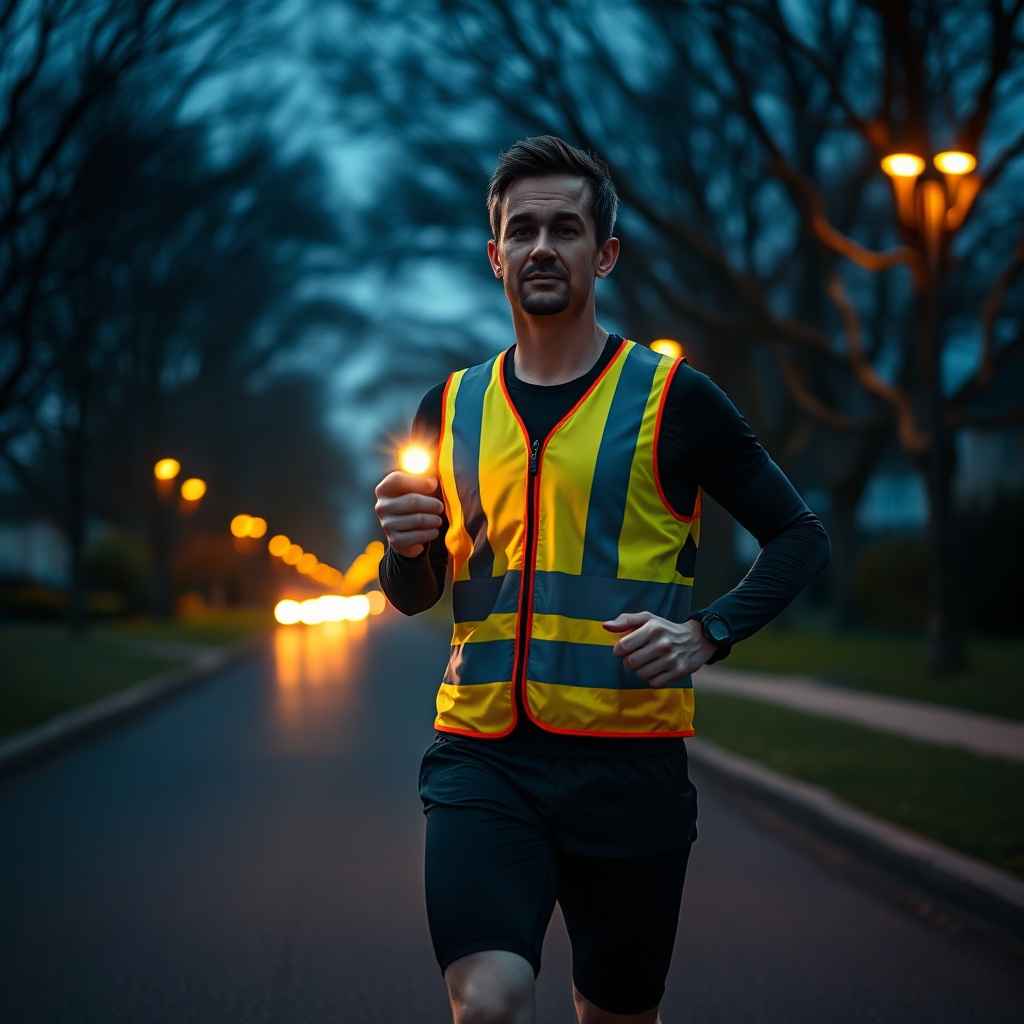
Visualizes the article’s core message that awareness is the primary weapon, showing a runner proactively monitoring their environment to avoid risks.
For runners, self-defense cannot be boiled down to a single martial arts technique. It is a dynamic, multi-layered system that integrates situational awareness, risk mitigation, de-escalation, and physical technique. The primary goal is to avoid a confrontation entirely, not to win a fight. Your best defense is to never become a victim in the first place.
Definition: Situational awareness is the practice of perceiving and understanding your environment and the people within it to identify potential threats before they materialize.
This approach means that physical techniques are a last resort, used only when all other layers have failed. The vast majority of your safety plan should be built on prevention, awareness, and verbal assertiveness. This proactive mindset is what separates a prepared runner from a passive one.
The Four Layers of Defense
Think of your safety as a series of protective layers. Each one is designed to stop an attack at a different stage. If one layer fails, the next one is ready.
- Layer 1: Preparation and Prevention: This is your foundation. It includes route planning, choosing safe times to run, and ensuring you are visible with reflective gear. It also means letting someone know your route and expected return time.
- Layer 2: Awareness and Avoidance: This is about reading the environment. It involves scanning for potential threats, trusting your intuition, and making proactive decisions to change your path or cross the street to avoid a potential problem.
- Layer 3: De-escalation and Verbal Assertiveness: This is the use of your voice to create space and deter a potential attacker. An assertive, commanding tone can interrupt a predator’s script and make them reconsider their target.
- Layer 4: Physical Response: This is the absolute last resort. It involves simple, effective techniques to break a grab or create an opening so you can escape and run away. The goal is not to fight, but to create a few precious seconds to get away.
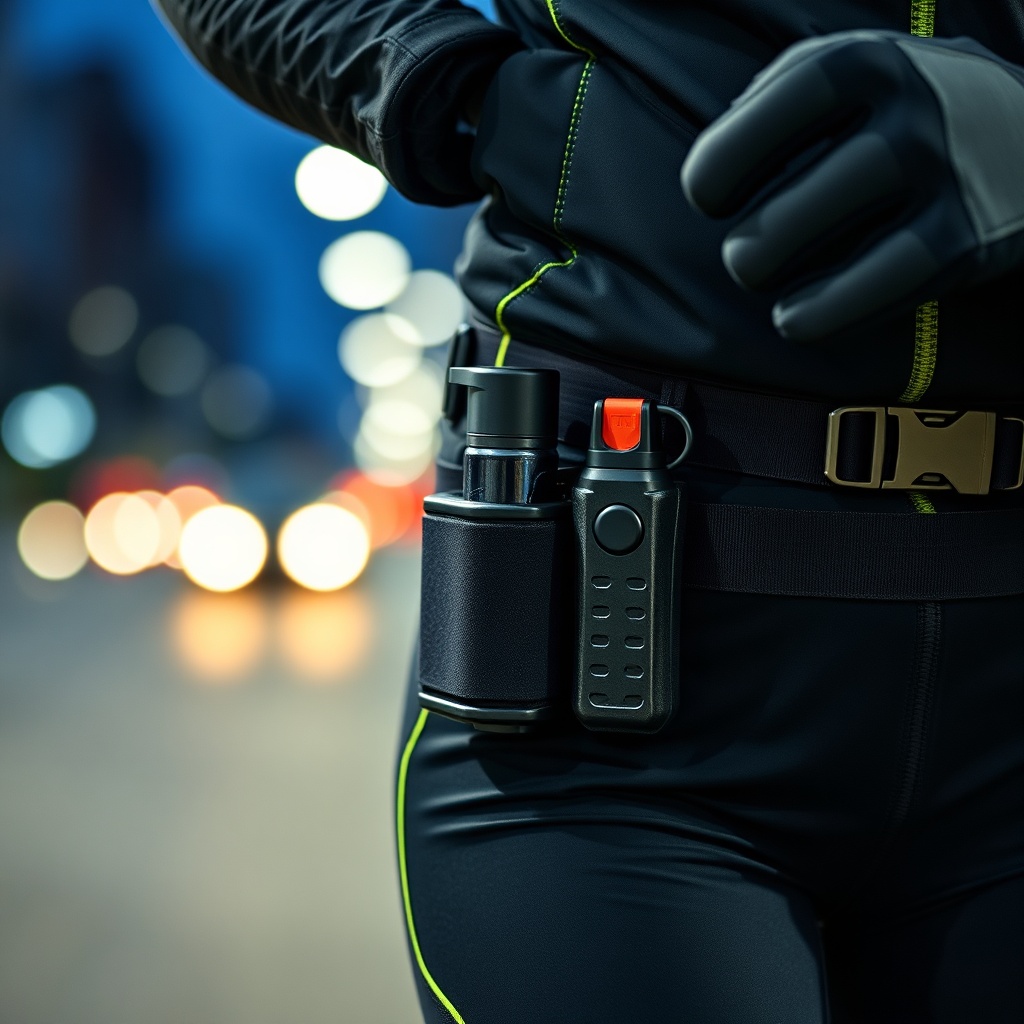
Illustrates the critical takeaway that safety gear must be accessible and practiced, depicting a runner ensuring their defense tools are secure and ready for immediate use.
The Role of Gear in a Defense Strategy
Gear like pepper spray or a personal alarm is a valuable tool, but it is not a substitute for awareness. It is a force multiplier that can give you a critical advantage in a dangerous situation.
The most important aspect of gear is accessibility. A tool buried in a deep pocket is useless when you need it. It must be in your hand or on a wrist strap, and you must practice drawing and deploying it so the action becomes muscle memory.
Furthermore, you have a legal responsibility to know the local regulations for carrying any self-defense device. Laws vary significantly by region, and it is your duty to research and understand what is legal in your area before you carry anything.
Assessing Your Risk: The First Step to Safety
Moving beyond a generic “be careful” warning is essential. A specific risk assessment is the first step to building a robust safety plan. This involves consciously evaluating risk based on time, location, and your personal profile before every run.
Time of Day and Location Factors
Risk profiles change dramatically between dusk, late night, and early morning. A route that is safe at 6 PM may have a completely different risk profile at 10 PM.
Route familiarity is paramount. You should know which areas have poor lighting, few escape routes, or are known “blind spots.” This is where the concept of “crime prevention through environmental design” (CPTED) becomes useful. When planning your route, choose paths with natural surveillance — meaning areas with open businesses, windows, or regular traffic. A well-lit street with active storefronts is a much safer choice than a dark, deserted park path.
Definition: Crime Prevention Through Environmental Design (CPTED) is an approach that suggests the design and use of the built environment can deter crime by increasing natural surveillance and reducing opportunities for offenders.
The “What If” Scenario Planning
Mental rehearsal is a powerful tool for improving your reaction time. By pre-planning your response to specific scenarios, you can avoid the freeze response that often occurs in a crisis.
Try to create simple “if-then” plans for common situations. For example: If a car slows down and follows me, I will immediately turn around and run in the opposite direction toward a well-lit area. Or: If a person approaches me on the sidewalk, I will cross the street and continue running in the opposite direction. By visualizing these scenarios, you are programming your brain to react automatically if they occur.
The Four Key Principles of Nighttime Defense
These principles are the core mindset and tactical strategies that underpin all other advice. They are the “how-to” for the mental and strategic side of defense.
Principle 1: Maximize Your Visibility and Awareness
Visibility has a dual role: seeing your environment and being seen by others. Your own vision is critical for spotting potential threats, which is why running in unlit areas is so dangerous. Being seen is equally important. High-visibility clothing with reflective elements ensures that drivers and other people can spot you from a distance, reducing the risk of accidental harm and making you a less appealing target for someone looking for an easy victim.
Your senses are your most important tools. This brings up the controversial topic of headphones. To maintain situational awareness while jogging, it is best to run without them. If you must use them, use only one earbud or a bone-conduction headset that leaves your ears open. Regularly performing “scans” is also crucial — look behind you, check the areas around parked cars and bushes, and scan the street ahead.
Principle 2: Trust and Use Your Intuition
A “gut feeling” is not magic; it is your subconscious mind pattern-recognizing potential danger. It is your brain picking up on subtle cues that your conscious mind hasn’t yet processed.
The rule is simple: If you feel unsure, act. It is always better to be embarrassed than assaulted. If a situation feels wrong, change your route, cross the street, or turn around. It is important to differentiate between irrational anxiety and a legitimate warning signal. If your discomfort is based on a specific, identifiable factor — a person, a car, a dark area — treat it as a legitimate warning and act on it.
Principle 3: Use Your Voice as a Primary Defense
Your voice is a powerful deterrent. The key is to learn the difference between “talking to a person” and “commanding a situation.” When you are in danger, you do not want to be polite; you want to be authoritative.
Use short, loud, and forceful commands like: “Back off!” or “Leave me alone!” The goal is to startle the person, interrupt their approach, and draw attention to the situation. De-escalation phrases are for non-threatening interactions. For example, if a person is asking for directions, a simple “No, sorry” while you continue moving is a de-escalation tactic. An assertive command is for when you feel threatened and need to create immediate space.
Principle 4: Create Space and Distance
Maintaining a safe distance from a potential threat is a fundamental principle of self-defense. The more space between you and a potential attacker, the more time you have to react.
Use your body language to appear confident. Stand tall, keep your head up, and make eye contact. A confident posture can make you look like a “hard target” and deter an attacker from choosing you. If you feel someone is following you, do not hesitate to change your direction or cross the street. Putting an object like a car or a fence between you and the other person can break their approach and give you a chance to run.
Practical Tools and Gear: A Comparison for Runners
Choosing the right gear is about real-world usability — accessibility, ease of use, and weight — over theoretical power. The best tool is the one you will actually carry and can deploy quickly.
The Gear Comparison Table
| Tool | Pros | Cons | Ease of Use While Running | Legal Considerations |
|---|---|---|---|---|
| Pepper Spray | Effective at stopping a threat from a distance; creates a burning sensation to incapacitate. | Can be affected by wind; requires precision to aim; must be checked for expiration. | Moderate. Best carried in hand or on a wrist strap for quick access. | Legality varies significantly by country, state, and city. You are responsible for researching local laws. |
| Personal Alarm | Very easy to use; extremely loud; excellent for startling an attacker and drawing attention. | Does not physically stop an attacker; relies on others hearing and responding. | High. Can be held in the hand or clipped to clothing. | Generally legal in most places, but it is still wise to check local regulations. |
| Tactical Flashlight | Bright light can temporarily blind and disorient a threat; useful for seeing your path. | Requires direct aim into the eyes to be effective; may not be enough to stop a determined attacker. | High. Can be worn on a wrist or held in the hand. | Generally legal to carry, but be aware of local laws regarding brightness and use. |
Quick Answer: The most practical self-defense tools for runners are a personal alarm for drawing attention and pepper spray for stopping a threat, but both require practice to be used effectively while on the move.
Remember that Your phone is a critical tool for calling for help, not for physical defense. It is essential for communication and should be easily accessible.
How to Choose and Carry Your Gear
The “carry position” of your gear is just as important as the gear itself. It must be in a hand or on a wrist strap, not buried in a pocket. If you have to fumble in a zippered pocket to get your safety tool, you have lost precious time.
Developing “muscle memory” is vital. Practice drawing and deploying your chosen tool at home so that the action is automatic. You should also have a simple rule for carrying your phone — for example, in a belt or armband — so you can access it quickly to call for help.
A Step-by-Step Action Plan for an Encounter
When a confrontation is imminent, you need a clear, sequential plan to follow. This translates theory into a practical response for the moment of crisis.
Quick Answer: If confronted while running, your response sequence should be: assess the threat, create distance, command verbally, deploy your tool, and then act to escape and run to safety.
The 5-Step Response Sequence
- Assess: Quickly evaluate the threat level and your immediate environment. Look for escape routes, bystanders, and any objects you can use to put between you and the person.
- Create Distance: Immediately back away. Put an object like a car, a fence, or a tree between you and the person to break their approach.
- Command: Use your voice assertively to tell them to “Back off!” or “Leave me alone!” A loud, commanding tone can be a powerful deterrent.
- Deploy: If they continue to approach, retrieve and ready your chosen self-defense tool. This is why having it accessible is so critical.
- Act/Evade: If they close the distance, use your tool or a targeted strike to create an opening, then run away immediately toward a safe, well-lit area.
Simple Physical Techniques for Escape
Physical defense should be focused on “break and run” techniques, not fighting. The goal is to create a few seconds of space to escape and call for help.
For a simple wrist grab, use the “pull and twist” motion. Pull your arm back sharply while twisting your wrist against the person’s thumb, which is the weakest part of their grip. This can break their hold and allow you to pull free.
A “palm strike” to the nose or chin is an effective way to create space. Use the heel of your palm to strike upward into the soft tissue of the face. This can stun the person and give you the opening you need to run.
Definition: A palm strike is a self-defense technique where the heel of the hand is used to strike a target, such as the nose or chin, to create distance from an attacker.
Frequently Asked Questions (FAQ)
Is it legal to carry pepper spray for self-defense while running?
The legality of pepper spray varies significantly by country, state, and even city. It is your responsibility to research and understand the specific laws in your area before carrying it. What is legal in one location may be illegal in another.
What is the best way to run with headphones safely at night?
If you must use headphones, use only one earbud or run in “transparency mode” to maintain situational awareness. A better alternative is to use a bone-conduction headset that leaves your ears open. The safest option is to run without them.
What should I do if I think I’m being followed while running?
Do not go home. Change direction immediately and head towards a well-lit, populated area like a 24-hour store or gas station. Call the police and keep them on the line while you move to safety.
Are personal alarms effective for runners?
Personal alarms are excellent for attracting attention and startling an attacker, which can give you precious seconds to escape. They are not a physical defense, but rather a tool for drawing help and creating a distraction.
Conclusion
Self defense for runners at night is a proactive, multi-layered strategy centered on awareness and avoidance. The best defense is to be a “hard target” — visible, alert, and confident. By implementing the principles of preparation, awareness, and verbal assertiveness, you can significantly reduce your risk and feel more in control.
Running at night can be safe and enjoyable with the right preparation and mindset. The goal is not to be afraid, but to be prepared. Start by reviewing the step-by-step action plan and select one new safety habit to implement on your next run. It could be as simple as planning your route more carefully or practicing your verbal commands. Small steps build lasting confidence.

