

Choosing a self-defense tool for running isn’t the same as choosing one for everyday carry. You are in motion, your hands are sweating, and your breathing is labored — all factors that can turn a standard pepper spray into a liability. While most guides focus on raw stopping power, the best pepper spray for runners 2026 prioritizes reliability, retention, and legal compliance above all else.
The landscape has shifted in the last year. Manufacturers have moved away from bulky keychains toward dedicated “runner’s grips” that integrate with your hand. Formulations have also been refined, with a stronger focus on UV marking dye for post-incident identification and wind-resistant nozzle technology that prevents blowback — a critical feature for anyone moving forward at speed.
This guide provides a definitive answer for 2026, breaks down the features that matter specifically to runners, and offers a practical buying guide to help you make an informed decision.
Key Takeaways
- The best pepper spray for runners is not the strongest spray, but the one you can deploy reliably while moving and breathing hard.
- The spray pattern (stream vs. cone) is a more critical decision for runners than the heat rating (SHU).
- Your local laws determine the legal pepper spray type and maximum size you can carry. Check before you buy.
- A dedicated carry method (hand strap or holster) is a non-negotiable feature for runners.
- Practice deployment is essential; familiarity beats raw power in a high-stress situation.
The Complete Answer: What Makes the Best Pepper Spray for Runners in 2026?
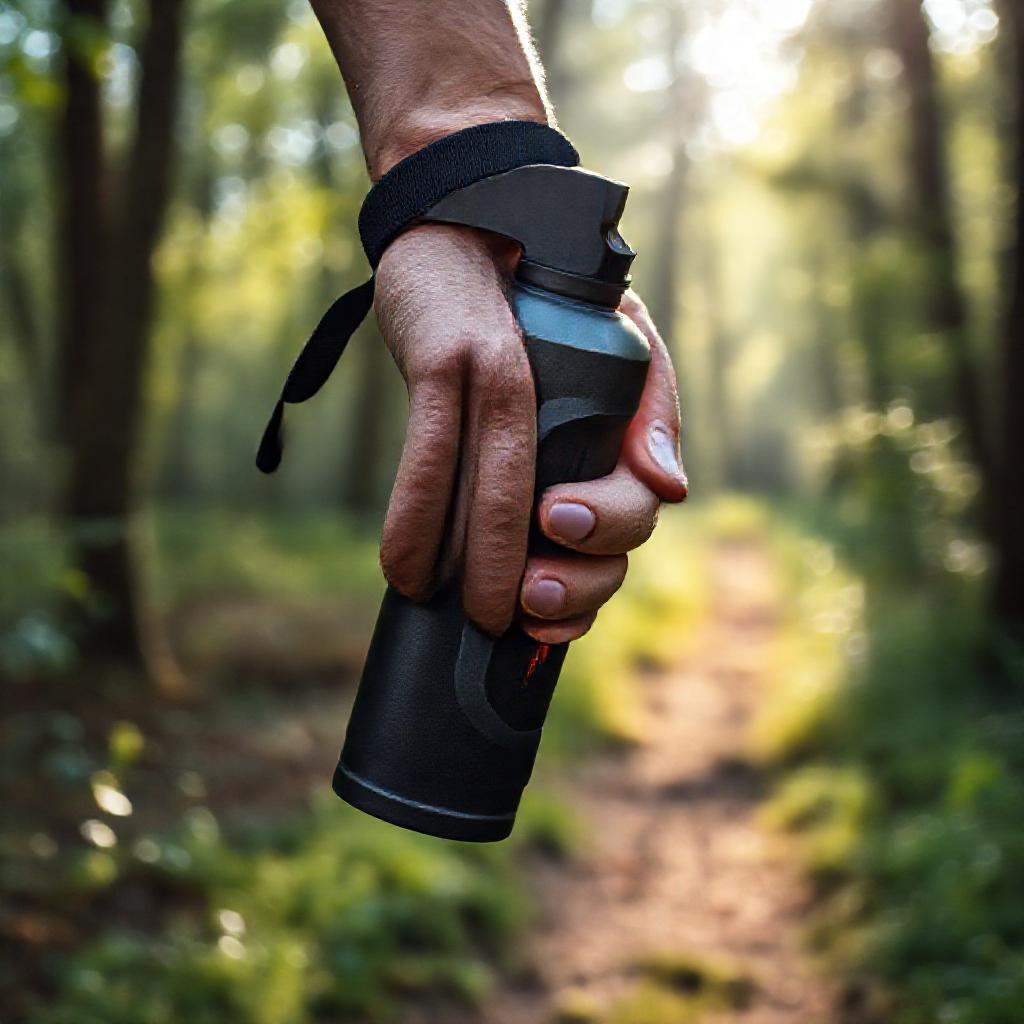
Lifestyle close-up highlighting retention, ergonomics, and quick-access design for active self-defense.
Quick Answer: The best pepper spray for runners in 2026 is a compact (under 2 oz), legal-in-your-area, police-grade stream spray with a 10+ foot range, a flip-top safety, and a hand strap for retention.
This specific combination wins for a few reasons. Compact size ensures the canister fits in a palm or small pocket without affecting your stride. A stream pattern is far less affected by wind than a cone or fog, which is crucial when you are the one creating the wind. The 10+ foot range allows you to maintain a safe distance from a threat without breaking your pace. Finally, a hand strap ensures the spray stays with you even if you are jostled or startled during an encounter.
The “Runner’s Rule” of Selection: The most important factor is not the spray itself, but the carry method that allows for immediate access. If you have to stop and dig in a pocket, you have lost the advantage.
The Evolution of Runner Defense: What’s New in 2026

Action-oriented visual emphasizing mobility, retention, and precise spray technology for active users.
From Keychains to Hand Straps: The Shift in Carry Design
Traditional keychain pepper sprays are awkward to access and can swing and hit your legs while running, disrupting your form and rhythm. The 2026 trend is the rise of dedicated “runner’s grips” — ergonomic, rubberized handles designed for a clenched fist, often with a hand strap or lanyard. This design philosophy is about keeping the tool in your hand, not in your bag, and comparing various options like those featured in 10 Best Self-Defense Weapons for Runners and Joggers online can help identify the most reliable carry systems.
Formulation Updates: UV Dye, Heat, and the “Fog” Debate
UV dye, also known as a marking agent, is now standard in most quality brands. It provides a valuable tool for post-incident identification by leaving a residue that is visible under ultraviolet light. When it comes to heat, it’s important to clarify that a high SHU number doesn’t always mean a better spray. The concentration of the active ingredient (OC) is what matters most.
Definition: OC concentration percentage refers to the amount of oleoresin capsicum (the active ingredient derived from hot peppers) in the spray. A higher percentage generally means a more potent effect.
The wind factor is a major liability for runners. A fog or cone pattern can easily blow back in your face, especially when you are moving forward. This is why a stream is the preferred choice for runners.
Legal Landscape Shifts in 2026
Laws governing pepper spray are not uniform. State-by-state variations exist, including maximum canister size and allowed chemical compounds. For example, some states may restrict canisters to a certain volume or prohibit certain chemical formulations. Always verify the legal restrictions for pepper spray by state before you buy, and cross-reference authoritative breakdowns like The legality and availability of personal security tools in the US products to ensure full compliance.
Airport and travel restrictions are also a concern. The Transportation Security Administration (TSA) has specific rules regarding pepper spray in checked vs. carry-on baggage. Generally, it is not allowed in carry-on luggage and has restrictions for checked bags. It’s essential to check the current regulations before you travel.
The Runner’s Arsenal: Comparing the 3 Essential Spray Types
Stream vs. Cone vs. Gel: A Direct Comparison for Runners
| Feature | Stream (The Runner’s Choice) | Cone / Fog | Gel |
|---|---|---|---|
| Wind Resistance | High — travels in a straight line | Low — can blow back on you | Very High — sticks to target |
| Range | 10-15 feet | 6-8 feet | 8-12 feet |
| Accuracy | High — requires less aim | Low — covers a wide area | Medium — requires good aim |
| Deployment Speed | Fast | Fast | Slow (thicker liquid) |
| Best For | Runners who need distance and precision | General self-defense, close contact | Runners in very windy, open areas |
The “Gel” Alternative: When It Makes Sense
A string pepper spray vs mist debate often overlooks gel. Gel is a good alternative for runners in very windy, open areas. Its pros are that it sticks to the attacker’s face and is less likely to contaminate the runner’s own hands or gear. The cons are slower deployment and a requirement for more precise aim. For most runners, a stream offers the best balance of speed and accuracy.
The 5-Step Runner’s Deployment Protocol: From Access to Action
Step 1: Pre-Run Preparation (The “Dry Run”)
Before every run, do a “draw and point” drill in a safe location to commit the motion to muscle memory. This is your dry run. Check the basics: verify the safety is off (or practice flipping it) and the canister isn’t expired.
Step 2: The “Runner’s Grip” — Maintaining Your Stride
The technique is to hold the spray in your dominant hand with the hand strap secure, keeping your arm relaxed and your stride natural. You should only bring the spray up to a ready position when you perceive a threat, not for the entire run. This helps maintain your pace and avoids alerting others unnecessarily.
Step 3: Create Distance and Issue a Verbal Command
The goal is to avoid a physical confrontation. Use a firm verbal command (“Back off!”) while maintaining your forward momentum or changing direction. The 10-foot range of a stream spray is your most important defensive tool, allowing you to create a buffer zone without engaging.
Step 4: The “Point and Press” Deployment
With your arm extended, aim for the center of the face (eyes/chest), and press the trigger for a sustained 1-2 second burst. Immediately after deploying, turn and run in a pre-planned direction — ideally toward a well-lit, populated area. Your speed is your best defense, and understanding the mechanics behind alternative deterrents, such as How Do Stun Guns Work? A Complete Beginner’s Guide to Voltage and Amps online, can further inform your overall safety strategy.
Step 5: Post-Incident Protocol
Your immediate actions are to run to safety, call 911, and describe the attacker and the location. If you got a small amount of the spray on your own skin, use soap and water, not just water, to decontaminate. The UV marking dye can help law enforcement identify the attacker.
The 4-Point Buying Guide: What to Look For in 2026
Point 1: The Carry System — The Most Overlooked Feature
A spray that isn’t immediately accessible is useless. Look for a hand strap, a dedicated running belt clip, or a safety holster placement for runners that attaches to your waistband. This is the most critical feature for a runner.
Point 2: Size and Weight — The “Invisible” Factor
The ideal canister is between 0.5 and 2 ounces. It should be small enough to not affect your form but large enough to hold a decent number of shots. The “pocket test” is simple: the spray should not bounce or chafe while you run. Many athletes prefer compact options, and checking reviews of the Cheetah Mini Jogger Stun Gun in Black products offers a practical example of lightweight carry solutions that won’t disrupt your stride.
Point 3: The Safety Mechanism — Fast vs. Foolproof
There is a trade-off between speed and security. A flip-top safety is fast and easy to open with your thumb, while a keylock safety is more secure but slower. For runners, the flip-top is the practical winner because speed is paramount. When weighing deterrent options, many refer to guides on Stun Guns vs. Pepper Spray: Choosing the Right Self-Defense Tool online to decide which mechanism best suits their personal comfort and legal requirements.
Point 4: Range and Shots per Canister
A spray with a range of at least 10 feet is essential. Look for a canister that provides at least 10-12 one-second bursts. You want enough for multiple deployments or to cover a mistake. This is also where waterproof pepper spray specifications matter — you need a canister that works even if it rains or you sweat heavily.
Legal and Safety Considerations for Runners
A Quick Legal Checklist Before You Buy
Before purchasing, you must research and verify the legal categories for your location. This includes canister size, OC concentration percentage, and prohibited locations like schools or airports. Laws change, so always check for the most current legal restrictions for pepper spray by state.
Safety Tips for Carrying and Using Pepper Spray
The “No Cross-Contamination” rule is vital. Always point the nozzle down when running to avoid accidental discharge, and store it in a separate pocket from your keys to prevent the trigger from being pressed. Also, check the expiration date on the canister. The active ingredient (OC) degrades over time, so you should replace your spray every 2-3 years, even if it hasn’t been used.
Frequently Asked Questions (FAQ)
Is pepper spray legal for runners in all states?
No, it is not. Laws vary significantly by state and even by city. You must verify the legal canister size and chemical composition for your specific location.
What is the best spray pattern for a runner — stream, cone, or gel?
A stream is the best for most runners because it is the most accurate and is not affected by the wind you create while running. A gel is a good alternative for very windy conditions.
How do I carry pepper spray while running without it bouncing or chafing?
The best method is a hand strap or a dedicated running belt holster. Pocket carry is generally not recommended as it is slow to access and can bounce. Some runners also explore alternatives like Stay Ahead of the Pack with the Cheetah Jogger Stun Gun products to stay protected while maintaining pace.
How many shots does a typical runner’s pepper spray contain?
A typical compact canister (0.5-2 oz) will contain enough for 10-12 one-second bursts. This is more than enough for a single encounter.
Does pepper spray expire, and how often should I replace it?
Yes, it does expire. The active ingredient (OC) degrades over time. You should check the expiration date and replace a canister every 2-3 years, even if it hasn’t been used.
Conclusion: Your Final Checklist for 2026
The best spray for you is the one that is legal, fits your hand, and can be deployed instantly. The final step is to physically test a few models to see which carry system and grip feel best in your hand. Remember the runner’s mantra: your spray is a tool to create an escape window, not a weapon to fight with. Your speed is your best defense.

