

Running at night is a practical necessity for many people. Between work, family, and daylight hours that shrink in winter, the only time to get a run in is after dark. But night running introduces unique risks that daylight running simply doesn’t have. Safe running at night is built on five rules: be seen, be predictable, be aware, run against traffic, and skip the headphones. These rules cover the core principles, gear, techniques, and habits that reduce your exposure to collision and harm — from the moment you step out the door to the moment you return.
Key Takeaways
- 10 Best Self-Defense Weapons for Runners and Joggers emphasize three non-negotiable pillars: visibility, predictability, and awareness.
- The single most effective gear upgrade is a bright, forward-facing light plus a rear-facing red blinker.
- Running against traffic is the standard rule for road running at night, but only when you have a safe shoulder.
- Your route should be planned for lighting, emergency access, and low-traffic conditions — not just distance.
- Night running safety is a habit: pre-run checks, in-run protocols, and post-run tracking all contribute to long-term safety.
The Complete Answer: What Safe Running at Night Actually Means
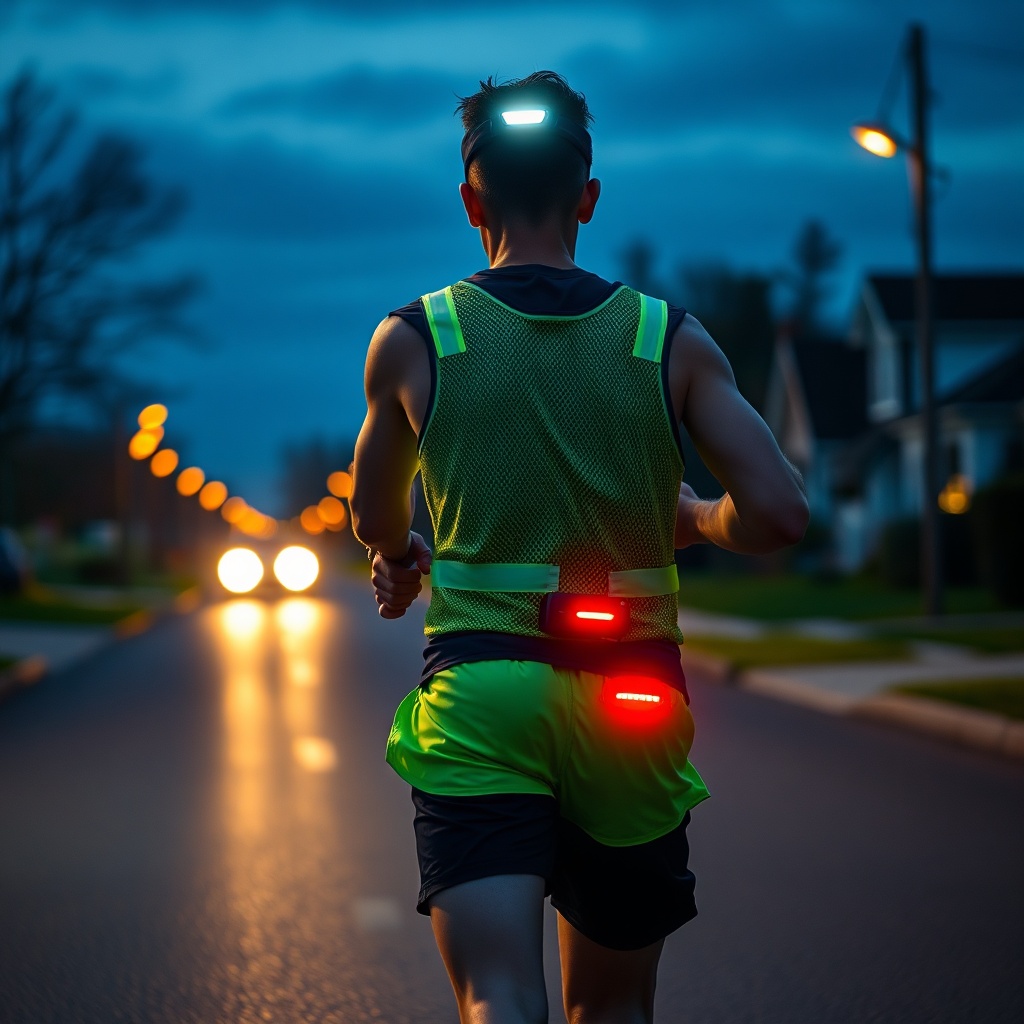
Highlights critical lighting and reflective gear that form the foundation of safe running at night.
Safe running at night is the practice of reducing your risk of collision and harm while running in low-light conditions. It is not a single action but a combination of three layers: making yourself visible to drivers and others, making your behavior predictable, and maintaining constant situational awareness. Each layer reinforces the others.
Visibility Is the Non-Negotiable Baseline
Visibility is the first and most critical layer of safe running at night. If you cannot be seen, no other technique matters. A driver who cannot see you cannot avoid you, no matter how predictable your route or how aware you are of your surroundings.
The elements of visibility include forward lighting, rear lighting, reflective material, and high-contrast clothing. A night running headlamp illuminates the path ahead and makes you visible to oncoming drivers. A rear-facing red blinker ensures that drivers approaching from behind can spot you. Reflective running apparel and LED running accessories, such as LED armbands and reflective vests, add passive visibility that works when light hits you.
Quick Answer: The most important thing for safe running at night is being visible. A forward-facing light plus a rear red blinker, combined with reflective gear, makes you far easier for drivers to see.
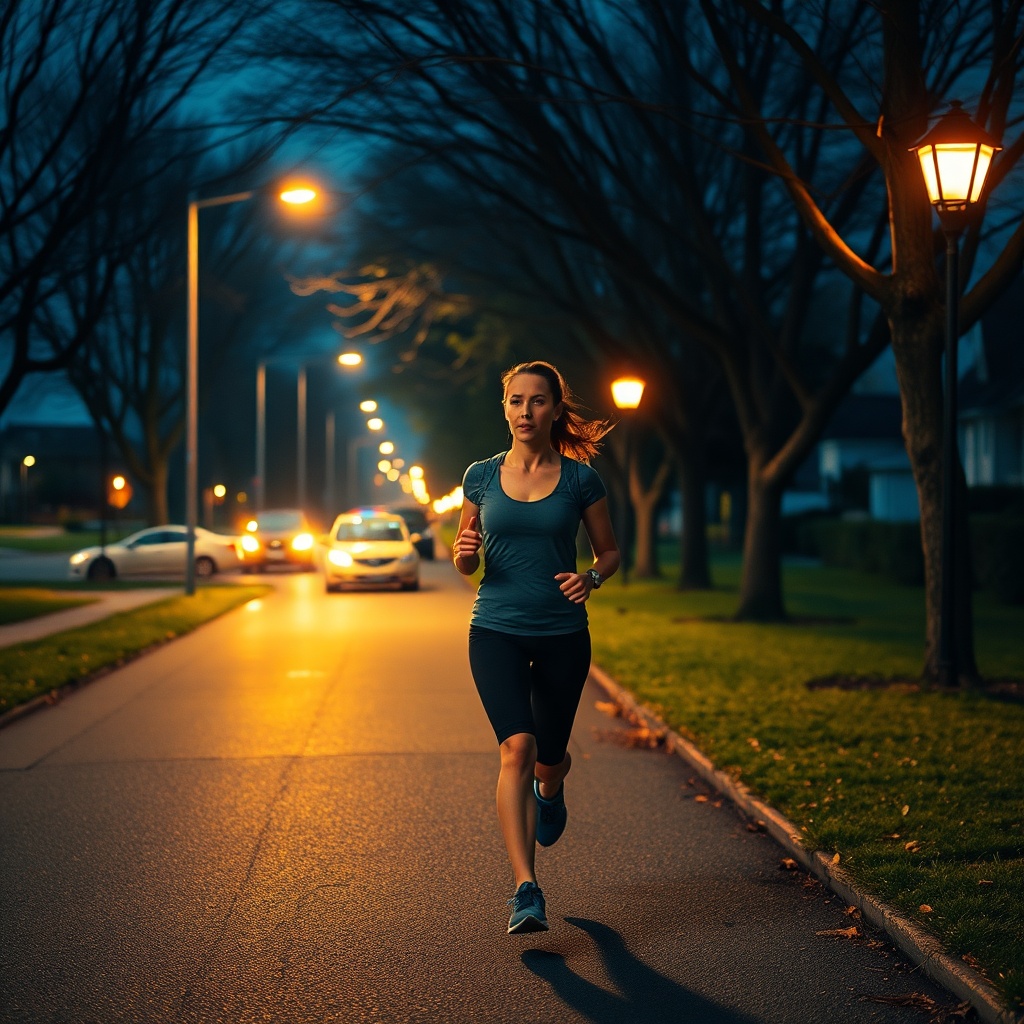
Visualizes key behavioral rules like staying alert and choosing illuminated routes for safer nighttime runs.
Predictability and Route Familiarity
Predictability means your movements are easy for drivers and others to anticipate. You run straight lines, avoid sudden turns, and use consistent crossing points. When you are predictable, drivers can plan around you rather than react at the last second.
Route familiarity eliminates surprises. You know where potholes, dark patches, and intersections are before you encounter them. Running on a familiar loop means you are not scanning for hazards while also trying to navigate. This is a core part of Stay Ahead of the Pack with the Cheetah Jogger Stun Gun — the less you have to think about where you are going, the more attention you can give to what is happening around you.
The “Three-Layer” Safety Model
Definition: The three-layer safety model is a framework for safe running at night that combines being seen, being predictable, and being aware. Each layer depends on the others.
The three layers work together as a single system. Being seen is useless if you are unpredictable — a driver who sees you but cannot anticipate your next move may still hit you. Being predictable is useless if you are oblivious — you can run straight and visible, but if you do not notice the car turning into a driveway, you are still at risk. And being aware is useless if you are invisible — you can know exactly where every car is, but if the driver cannot see you, awareness alone will not save you.
Pre-Run Preparation: Gear and Route Planning
Stay Prepared: 10 Tips for Personal Safety in Uncertain Times products starts with the gear you choose and the route you select. The decisions you make before you leave the house matter as much as what you do while running.
Essential Gear: Lights, Reflectors, and Clothing
The minimum viable gear for safe running at night includes a headlamp or handheld light, a rear red light, and reflective elements on your clothing or shoes. That is the baseline — three items that cover the essential visibility needs.
There are trade-offs among different visibility solutions. A headlamp gives you a focused beam that illuminates the path ahead, but it can blind oncoming drivers if aimed too high. A handheld light is more controllable but takes up a hand. Reflective gear is passive and requires no battery, but it only works when light hits it. High-visibility clothing in neon yellow or orange works well in urban areas with ambient light, but it does not make you visible to headlights unless it is also reflective. The best lighting gear for night runs combines active lights with passive reflectivity.
Quick Answer: The minimum gear for safe running at night is a headlamp, a rear red blinker, and reflective elements on your clothing or shoes. Add high-visibility clothing for urban routes with ambient light.
Route Selection: Lighting, Traffic, and Emergency Access
When you select a route for night running, evaluate it for street lighting density, traffic volume and speed, shoulder width, and the presence of sidewalks or bike lanes. A route that is fine in daylight can be dangerous at night if it lacks lighting or has fast, heavy traffic. These are common night running hazards that you can avoid with careful planning.
Emergency access is a key consideration. You want safe running routes where you can quickly reach a lit building, a gas station, or a 24-hour store if needed. This is part of evening run route planning — you should know where you can get help before you need it.
The Pre-Run Checklist (Step-by-Step)
Run through this checklist before every night run:
- Charge or test your headlamp and rear light.
- Check that reflective clothing is clean and visible (not covered by a dark jacket).
- Confirm your route on a map and note any closed sections or construction.
- Share your planned route and estimated return time with someone.
- Bring your phone with a full battery and a personal alarm or whistle.
- Check the weather forecast for rain or fog, which reduce visibility.
- Verify that your shoes have any reflective elements intact (or add reflective shoe clips).
Running Techniques and Habits for Night Safety
Your behavior while running matters as much as your gear. How you move, where you position yourself, and how you use your senses all contribute to safe running at night.
How to Run Against Traffic
The standard rule for road running at night is to run against the flow of traffic. This allows you to see oncoming vehicles and react to them. When you run with traffic, cars approach from behind and you cannot see them coming.
There is an exception: if there is no safe shoulder, running with traffic on a wide sidewalk may be safer. But if you do that, you must rely more heavily on rear visibility, since drivers will not see you as early. Check local traffic laws regarding running direction, as some areas have specific rules.
Using Your Senses: Visual and Auditory Awareness
Visual awareness at night means scanning ahead, using your peripheral vision, and avoiding staring at your feet or a single light source. Your headlamp can create a tunnel-vision effect if you focus only on the beam. Use your peripheral vision to catch movement at the edges of your field of view.
Auditory awareness is equally important. Keep one ear free or use bone-conduction headphones if you choose to use audio at all. Full noise-cancelling headphones at night remove a critical early-warning system. You cannot hear an approaching car, a cyclist, or a person behind you, which makes you more vulnerable.
The “No-Headphones” Rule (or How to Use Them Safely)
The strict rule is simple: no headphones when running at night on roads with traffic. This is not about audio quality — it is about preserving your ability to hear approaching cars, cyclists, or people.
For those who insist on audio, define a safe alternative: use only one earbud, keep volume below the level of ambient noise, or use bone-conduction headphones. These options preserve some auditory awareness while still allowing you to listen to music or a podcast.
Handling Specific Night-Time Scenarios
Night running presents unpredictable situations that require specific responses. Safe running at night means knowing how to handle these scenarios before they happen.
Urban vs. Suburban vs. Trail Night Running
Urban night running has high ambient light but many intersections, crosswalks, and distracted drivers. Use crosswalks, avoid jaywalking, and stay on the sidewalk.
Suburban night running has fewer lights, wider roads, and higher vehicle speeds. Prioritize routes with sidewalks or wide shoulders.
Trail night running has no traffic but uneven ground, wildlife, and limited emergency access. Use a brighter headlamp and consider running with a buddy.
What to Do When a Car Approaches
When a car approaches, follow these steps: (1) Move toward the edge of the road or sidewalk, (2) Make eye contact if possible, (3) Slow down or stop if the car appears to be turning, (4) Never assume the driver sees you.
The “flash” technique can help draw attention. Use your hand to point your headlamp at the car, or wave your arm, to make yourself more noticeable. This is especially useful at intersections where drivers may be looking for cars, not pedestrians.
Dealing with Animals and Pedestrians
Animals can be a significant hazard at night. Dogs are more likely to be active or off-leash after dark. Carry a light or whistle to deter them, and avoid running near unfamiliar properties with dogs.
Pedestrians are also a concern. At night, you may encounter people who cannot hear you approaching. Announce yourself by saying “on your left” or “passing” before you get too close. This prevents startling them and prevents collisions.
Post-Run and Long-Term Safety Habits
Safety does not end when you finish your run. The post-run period and your long-term habits are part of safe running at night.
Cool-Down and Recovery in the Dark
There is a risk in lingering in a dark area after a run. Your body is tired, your awareness drops, and you are a less visible target. Finish your cool-down in a well-lit, populated area or move directly inside. This is a simple but important part of Staying Safe on the Go: The Role of Pepper Spray in Personal Security.
Tracking Your Runs and Sharing Your Location
Use run-tracking apps with live location sharing so someone can see your progress in real time. Set up a “check-in” protocol: send a message when you start and when you finish. This is a low-effort, high-value habit for solo night runners.
Building a Night-Running Community or Buddy System
Empowering Women: The Importance of Personal Safety is the single most effective way to reduce risk. Two people are more visible and more able to respond to an emergency. Join or form a local night-running group, or partner with a neighbor who has a similar schedule. Structure a buddy run with the same pace, the same route, and an agreed emergency plan.
Comparison Table: Reflective Gear vs. LED Lights vs. High-Vis Clothing
| Feature | Reflective Gear | LED Lights | High-Vis Clothing |
|---|---|---|---|
| How it works | Bounces light from car headlights back to the driver | Emits its own light, visible from a distance | Uses bright colors (neon yellow, orange) to contrast with the environment |
| Best used for | Running on roads with steady traffic | Running in completely dark areas or on trails | Running in urban areas with ambient light |
| Visibility distance | Requires a light source to be effective | Visible even with no external light | Visible during the day, less effective at night without reflectivity |
| Key limitation | Useless if no car headlights are present | Battery life and weight | Does not make you visible to a driver’s headlights unless it is reflective |
| Recommended combination | Pair with LED lights | Pair with reflective elements | Pair with reflective strips or a reflective vest |
Frequently Asked Questions
How many lumens do I need for a night running headlamp?
The most important factors are beam pattern and battery life, not raw lumens. A headlamp with a focused beam for the path and a wider flood for peripheral vision is ideal. Choose a headlamp with a beam that lets you see the ground ahead clearly without blinding oncoming drivers.
Is it safer to run with or against traffic at night?
Run against traffic so you can see oncoming vehicles. The exception is when you have a safe sidewalk or shoulder — in that case, running with traffic on the sidewalk may be safer, but you must rely on rear visibility.
Can I wear headphones while running at night?
No headphones on roads with traffic. If you must, use one earbud or bone-conduction headphones at low volume so you can still hear approaching vehicles.
What is the best color to wear when running at night?
Neon yellow, orange, or white are the best choices. But color alone is not enough — you also need reflective elements and active lights.
Should I carry a weapon or pepper spray for night running?
This is a personal choice and may be subject to local regulations. Consider alternatives: a whistle, a personal alarm, or a Cheetah Mini that can be used to disorient.
Conclusion
Safe running at night is not about one piece of gear or one rule. It is a layered approach that combines visibility, predictability, and awareness. By preparing before you leave, practicing safe techniques while you run, and building long-term habits, you can enjoy the benefits of night running with meaningful risk reduction. Always verify the specific gear standards and local regulations relevant to your area.

