

Tactical Self-Defense Tools 2026: Definitive Guide & Buyer’s Blueprint
Choosing the right tactical self-defense tools 2026 requires navigating a complex landscape of shifting legal frameworks, evolving threat models, and innovative materials. This guide cuts through the noise, offering a practical blueprint for everyday civilians to select, legally carry, and effectively train with personal defense tools. We will focus on practical, legal, and effective options for everyday civilians, not military or restricted gear.
Key Takeaways
- The most effective self-defense tool is one you can carry consistently and deploy under stress; 2026 trends emphasize lightweight, discreet, and legally compliant options.
- Legal restrictions vary drastically by jurisdiction; always verify local laws before purchasing any tool.
- Training and muscle memory are more critical than the tool itself — a simple tool with practice outperforms a complex one without.
- Multi-functional tools (e.g., flashlight + striker) are gaining popularity for their everyday utility and defensive versatility.
- Non-lethal options (OC spray, stun guns) remain the top choice for most civilians due to lower legal and ethical risk.
The Complete Answer: What Are the Best Tactical Self-Defense Tools in 2026?
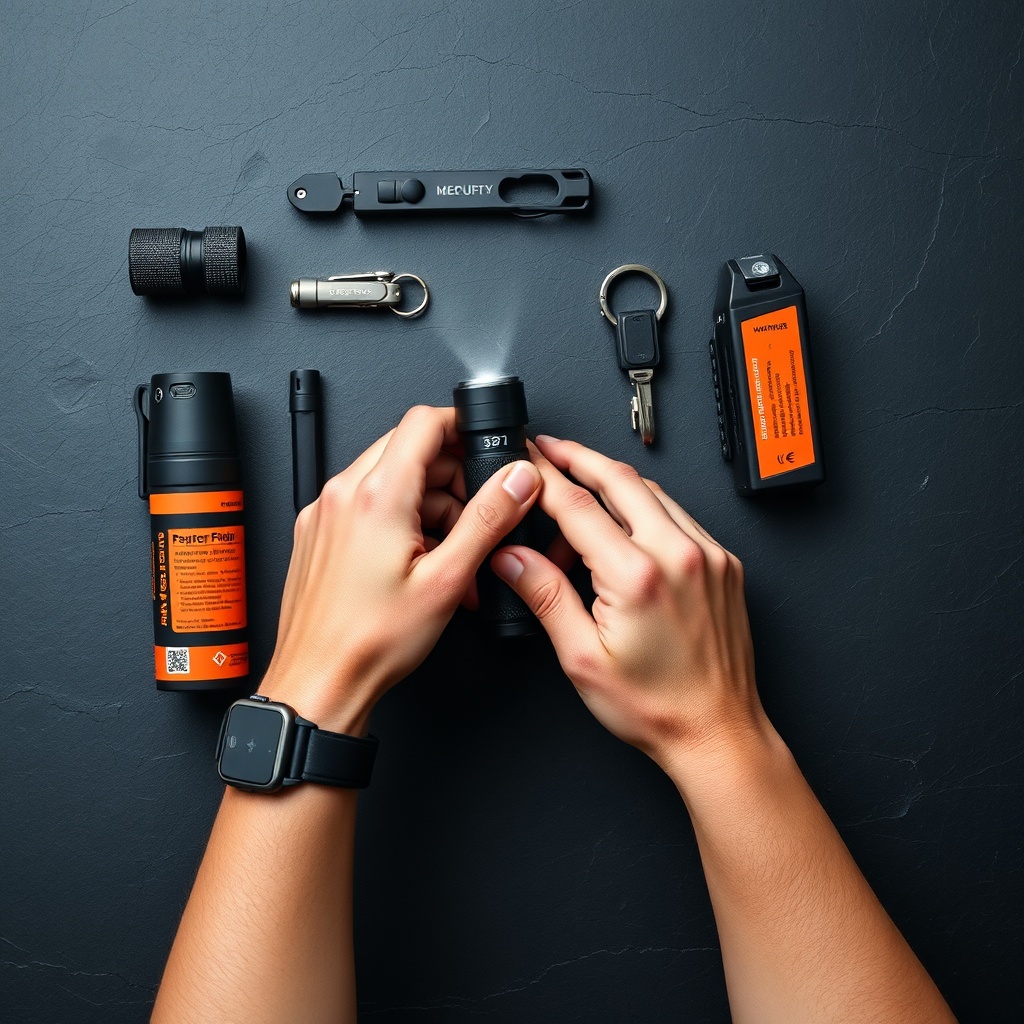
A comprehensive display of recommended non-lethal personal defense items suitable for daily carry, highlighting versatility, discretion, and legal compliance for modern safety.
The best tactical self-defense tools 2026 are those that balance stopping power, portability, and legal compliance. The top categories for most civilians are pepper spray, stun guns, tactical flashlights, self-defense keychains, and compact fixed-blade knives. The “best” tool for you depends on your environment, skill level, and local laws.
Quick Answer: The best self-defense tool is the one you will actually carry every day and have trained with. For most people, this starts with a high-quality pepper spray or a tactical flashlight, both of which offer a strong balance of legal safety and defensive capability.
How to Choose Based on Your Daily Carry Profile
Your choice of self-defense tool should be dictated by your daily routine and the specific threats you are most likely to face.
- Urban Commuter: Your focus is on discreet, easily accessible tools. A pepper spray keychain or a tactical pen that can be used for pressure points is ideal for navigating crowded streets and public transit.
- Night-Shift Worker: Your primary defense is illumination. A high-lumen tactical flashlight with a strobe function can disorient a potential attacker from a safe distance and provide a path to escape. Consider adding a stun gun for close-quarters scenarios.
- Outdoor Enthusiast: Your needs include utility and durability. A compact fixed-blade knife can serve both as a camp tool and a last-resort defense, while a robust pepper gel is wind-resistant and effective in open environments.
To make a decision, consider this flow: If you live in a state with strict knife laws, prioritize OC spray. If you work late nights, add a high-lumen flashlight. If you want a tool that is always with you, consider a keychain or tactical pen.
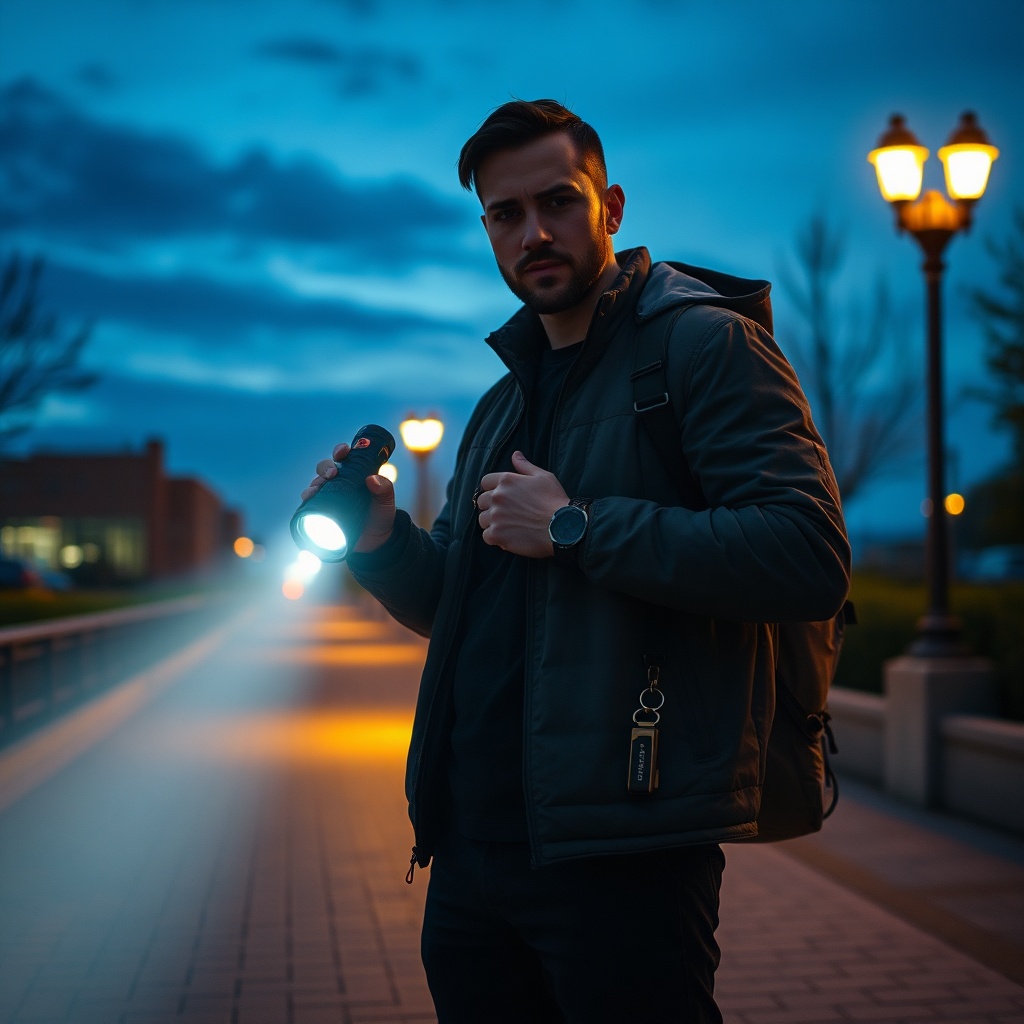
Action-oriented depiction of a person utilizing a high-intensity tactical flashlight to navigate and assess surroundings safely during low-light conditions, emphasizing the importance of light in personal defense.
The 2026 Shift: Smart and Integrated Tools
The most significant trend in tactical self-defense tools 2026 is the move towards integration. Tools are no longer just weapons; they are everyday items with a defensive purpose. This aligns with the “grey man” principle—the idea of not standing out or looking like you are armed.
- Everyday Carry (EDC) Integration: Tools like tactical pens with glass breakers, carabiner-style stun guns, and multi-tools with built-in defense features are gaining popularity. They provide utility while offering a Hidden Protection: discreet defensive option.
- Smart Technology: While specific features vary, the direction is clear: tools are becoming “smart.” This includes components like smart alarms with location sharing, which can notify trusted contacts if you trigger an alert, and wearable panic button technology that can be activated discreetly.
Definition: The “grey man” principle is a concept in personal defense where an individual deliberately avoids drawing attention to themselves by blending into their environment, carrying tools that appear mundane rather than tactical or weapon-like.
Legal Landscape and Compliance: What You Must Know Before Buying
Understanding The legality and availability of personal security tools in the US is crucial because the legal landscape for tactical self-defense tools 2026 is a patchwork of regulations. Understanding the difference between concealed carry permits, prohibited weapons lists, and “less-lethal” classifications is crucial. Ignorance is not a defense; a tool that is legal in one state can be a felony in another.
State-by-State Variations (General Guidance, Not Legal Advice)
Laws governing self-defense tools vary widely across the United States. They generally fall into broad categories:
- Restrictive States: These states often have strict prohibitions on stun guns, certain types of knives (e.g., switchblades, gravity knives), and may require permits for OC spray. Examples include Hawaii, Massachusetts, and Rhode Island.
- Moderate States: These states permit most non-lethal tools but have specific restrictions on blade length or the “disguised” nature of a weapon (e.g., a keychain that looks like a weapon).
- Permissive States: These states have fewer restrictions on non-lethal tools and knives, but you must still be aware of local city or county ordinances.
Crucial Advice: Always check local laws via official government websites before purchasing any tool. Pay special attention to regulations regarding transporting tools across state lines, as what is legal in your home state may be illegal in a neighboring one.
Legal Use of Force: When Is It Justified?
Even if a tool is legal to own, its use is governed by the legal concept of “reasonable force” and “proportionality.” The force you use must be proportional to the threat you face. For example, using a knife against an unarmed person who is shouting at you would likely be considered excessive and illegal.
Using any tool, even a non-lethal one like pepper spray, can have legal consequences, including civil liability and criminal charges. It is your responsibility to understand the laws in your jurisdiction and to use force only when you have a reasonable belief that you are in imminent danger of harm.
In-Depth Tool Categories: Pros, Cons, and Real-World Applications
Moving beyond a simple list, it’s important to analyze the trade-offs between stopping power, portability, and legal risk for each category.
Pepper Spray and OC/CS Gas
When weighing options like Stun Guns vs. Pepper Spray: Choosing the Right Self-Defense Tool, pepper spray is often the first and best recommendation for beginners. It is non-lethal, easy to use, and effective at a range.
- Pros: Non-lethal, easy to use, effective at range, widely legal, and provides a valuable deterrent.
- Cons: Can be affected by wind (blowback), has a shelf life (typically 2-4 years), and requires practice for quick deployment.
How to Choose: The spray pattern matters. Stream provides the longest range and is least affected by wind, making it ideal for outdoor use. Cone offers a wider coverage area, useful for moving targets. Fog creates a large cloud, which can be effective in enclosed spaces but is highly susceptible to wind.
Quick Answer: Pepper gel is a type of OC (oleoresin capsicum) spray that is thicker than a liquid, making it more resistant to wind and less likely to blow back onto you.
Stun Guns and Tasers
Stun guns and tasers are effective non-lethal options that cause temporary incapacitation through electrical shock.
- Pros: Immediate incapacitation, no permanent damage, and some models have built-in flashlights.
- Cons: Contact stun guns require close contact (which can be dangerous), battery reliability is a concern (they must be charged regularly), and they are restricted in some areas. For detailed specs, review Cheetah Flash Light Stun Guns: A Comprehensive Guide to Personal Protection products. A top recommendation is the Cheetah Slim Max Power Stun Gun in Black online.
Sub-topic: It’s vital to understand the difference between contact stun guns and projectile tasers. A contact stun gun requires you to touch the attacker to deliver a shock. A projectile taser (like those made by TASER) shoots barbed probes from a distance. The legal status of these two types varies significantly, with projectile tasers often being more strictly regulated.
Definition: A stun gun is a device that delivers an electric shock through direct contact. A taser is a brand of conducted electrical weapon that fires two barbed probes to deliver an electric shock from a distance.
Tactical Flashlights (High-Lumen, Strike Bezel)
A tactical flashlight is arguably the most versatile and legally safest self-defense tool available.
- Pros: Dual-purpose (illumination + defense), virtually always legal, and non-lethal.
- Cons: Requires aiming at the eyes to be effective, and the light alone may not be enough against a determined attacker.
Sub-topic: When choosing a flashlight, look at candela, not just lumens. Lumens measure total light output, but candela measures the intensity of the beam. A high-candela beam is focused and can be very disorienting when shined in an attacker’s eyes, especially with a strobe function.
Self-Defense Keychains and Kubotans
A kubotan is a small, rod-like tool that can be used for pressure points and strikes.
- Pros: Discreet, always with you, and can be used for pressure points and strikes without causing lethal injury.
- Cons: Requires close-quarters training to be effective, and may be classified as a weapon in some jurisdictions.
Sub-topic: The legal gray area of “weapons disguised as objects” is a real risk. A keychain that looks like a weapon might be considered a concealed weapon in some places. Know the risk and understand how your local laws define such items.
Compact Fixed-Blade Knives (for Defense)
A compact fixed-blade knife is a last-resort option that requires a high level of commitment.
- Pros: Reliable, no batteries, and can be used for both utility and defense.
- Cons: High legal risk, requires significant training, and carries the potential for serious injury (both legally and ethically).
Sub-topic: Blade length and design are critical. In many areas, a knife with a blade under a certain length (often 2.5 to 3 inches) is legal to carry openly or concealed. However, “intent” is a key factor; carrying a knife for self-defense can be viewed differently than carrying one for utility. Always err on the side of caution.
Comparison Table: Tactical Self-Defense Tools at a Glance
This table compares the five main categories across key factors. Legal risk is based on average U.S. laws and varies by state.
| Tool Category | Legal Risk (Average) | Stopping Power | Ease of Use | Portability | Training Required |
|---|---|---|---|---|---|
| Pepper Spray | Low | Medium | High | High | Low |
| Stun Gun | Medium | High (close) | Medium | Medium | Medium |
| Tactical Flashlight | Very Low | Low-Medium | High | High | Low |
| Keychain/Kubotan | Medium | Medium (close) | Medium | Very High | High |
| Fixed-Blade Knife | High | High | Medium | Medium | High |
How to Train and Integrate Your Tool into Daily Life
The tool is only 10% of the equation; the other 90% is mindset and muscle memory. By mastering Empowering Yourself: The Use of Non-Lethal Self-Defense Techniques products, training becomes what separates someone with a self-defense tool from someone who is prepared to use it.
Step-by-Step: 5-Day Beginner Training Protocol
- Day 1 – Familiarization: Practice drawing and deploying your tool 20 times slowly, focusing on smooth motion. This builds the initial neural pathway for the action.
- Day 2 – Grip and Stance: Work on a proper defensive stance (bladed) and maintaining a firm grip under simulated stress. Your stance should be stable and allow for quick movement.
- Day 3 – Target Acquisition: Practice hitting a target (e.g., a paper plate) at varying distances with your chosen tool. This could be a spray pattern, a flashlight beam, or a strike with a kubotan.
- Day 4 – Scenario Drills: Set up a mock scenario (e.g., someone approaching aggressively) and practice your response, including verbal commands like “Back up!” or “Stay away!”
- Day 5 – Integration: Carry the tool for a full day and practice drawing it at least 10 times in different situations (sitting, walking, with bags) to build habit and ensure the tool is accessible in all your daily routines.
Building a “Defense Mindset” Beyond the Tool
A tool is just a tool. The most critical component of your defense is your mindset. This includes:
- Situational Awareness: Being aware of your surroundings at all times. This is your first line of defense.
- De-escalation: Using verbal skills to calm a situation and create distance between you and a potential threat.
- Escape: The best self-defense is avoiding the fight altogether. Your primary goal should always be to escape to safety, not to win a confrontation.
FAQ: Common Questions About Tactical Self-Defense Tools in 2026
Q: Are stun guns legal in all states? A: No. Several states (e.g., Hawaii, Massachusetts, Rhode Island) have restrictions or require permits. Always check your local laws before purchasing.
Q: What is the best self-defense tool for a beginner? A: Pepper spray is widely considered the safest and most effective starting point due to its low legal risk, ease of use, and non-lethal nature.
Q: Can I carry a tactical flashlight as a weapon? A: While a flashlight is generally legal, using it as a weapon could be interpreted as assault. It’s best to use it for illumination and disorientation, then retreat.
Q: How often should I practice with my self-defense tool? A: At least once a week for basic drills, and monthly for full scenario practice to maintain muscle memory.
Q: What should I do if I accidentally spray myself with pepper spray? A: Flush with water (not soap) for at least 20 minutes, avoid touching your eyes, and seek medical attention if irritation persists.
Conclusion
Choosing the right tactical self-defense tools 2026 comes down to three key principles: choose a tool that fits your lifestyle, verify its legality, and invest in training. The best tool is the one you have with you and know how to use. Prioritize avoidance and de-escalation above all else.
Take the next step today: research your local regulations and start with a simple, effective tool like a high-quality pepper spray or tactical flashlight. Your safety is an active practice, not a passive purchase.

