

Stun gun laws by state are not uniform, and understanding the specific rules in your jurisdiction is the first step to legal carry and self-defense planning. The legal landscape for stun guns is a patchwork, with restrictions ranging from outright bans to no restrictions at all. This guide provides a Florida Stun Gun Laws: Is It Legal to Carry in 2026? (Updated Guide) online, the federal baseline, and the specific nuances that differ, including ownership rules, carry requirements, brand restrictions, and age limits.
Note on Data: All specific legal citations, age limits, and prohibited areas mentioned below are common points of regulation. You must verify them against current state statutes before relying on them, as laws change frequently.
Key Takeaways
- Stun guns are legal in the majority of U.S. states, but the specific rules on carry, age, and permitted locations vary significantly.
- The federal law (18 U.S.C. § 930) prohibits stun guns in federal facilities and on commercial aircraft, but state law controls general possession and carry.
- Several states restrict stun guns to individuals over 18, while a few require a concealed carry permit or a license to possess.
- Some states prohibit stun guns entirely or require them to be registered, and local ordinances can be stricter than state law.
- Always verify the law in both your home state and any state you travel to, as possession can be a felony in some jurisdictions.
The Complete Answer: What Are the Stun Gun Laws by State?
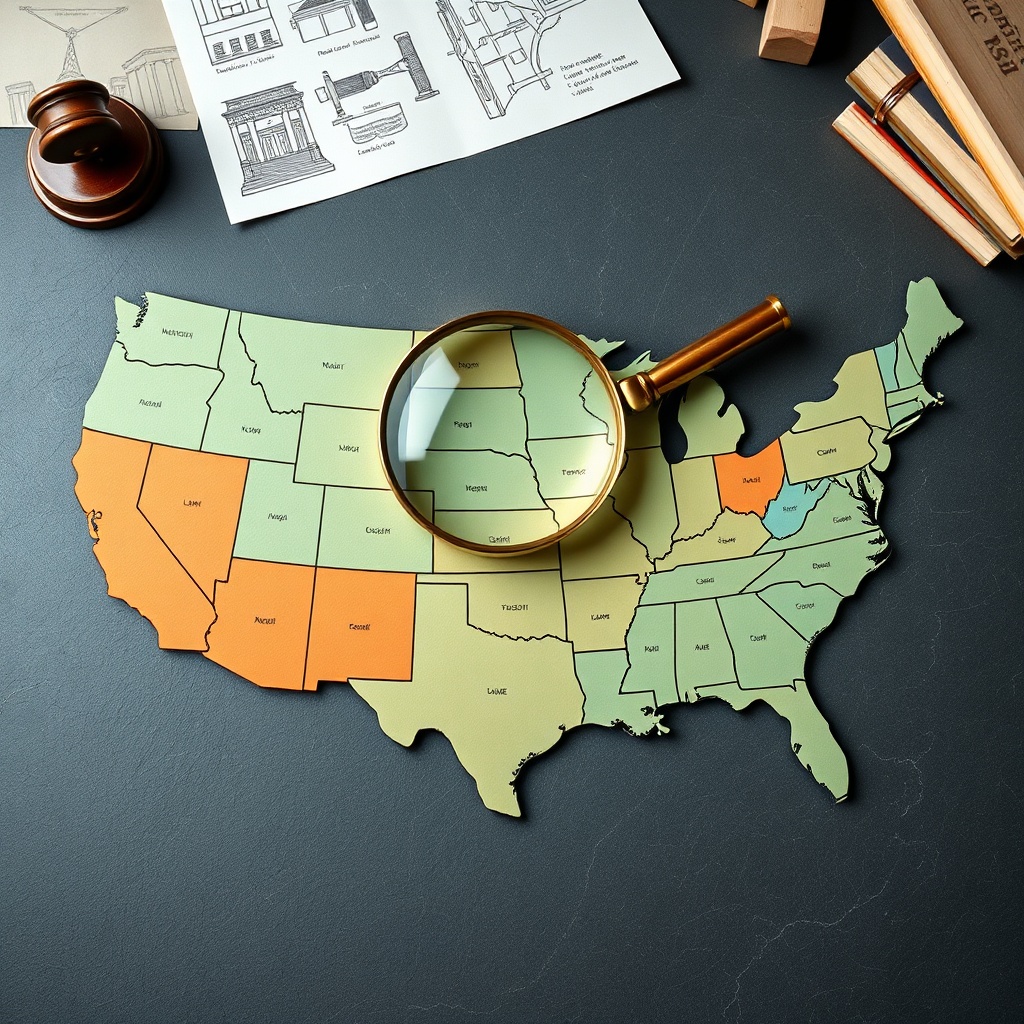
A conceptual map graphic illustrating the fragmented regulatory environment of stun guns across different US jurisdictions.
Stun guns are legal in almost all U.S. states, but the laws governing their possession, carry, and use are not uniform. As of 2026, only a handful of states have specific restrictions or bans, while others allow them without a permit. The most common restrictions involve age (minimum 18), prohibited locations (schools, government buildings, airports), and the requirement for a concealed carry permit in certain states.
Quick Answer: Stun guns are legal in the vast majority of U.S. states, but a few states impose outright bans, permit requirements, or specific age restrictions. The laws are not federal; they are determined by each state’s statutes and local ordinances.
Federal Baseline
The federal government prohibits stun guns in federal courtrooms, federal buildings, and on commercial flights. This applies nationwide regardless of state law. This is a crucial baseline to understand, as it affects anyone who travels with a stun gun, even if their home state allows it.
An editorial still life symbolizing responsible ownership and the verification of local regulations for self-defense tools.
How to Use This Guide
This article organizes state laws into categories (fully legal, permit required, restricted, banned) and provides a step-by-step process for verifying the law in your specific state. Use the categories to get a general sense of your state’s approach, but always confirm the details with the official statutes.
The Three Legal Categories of Stun Gun Ownership
To simplify the patchwork of regulations, stun gun laws by state generally fall into three main categories. Understanding which category your state falls into is the first step to legal compliance.
Category 1: Fully Legal with No Permit (Majority of States)
These states treat stun guns like ordinary personal property, with no licensing or registration required. Age restrictions may still apply (typically 18+), but no permit is needed for open or concealed carry. Many states in the South and Midwest fall into this category. In these jurisdictions, the primary legal considerations are prohibited locations, such as schools and government buildings.
Concrete Examples (Category 1):
- Florida: Legal for individuals 18+. Prohibited on school grounds (Fla. Stat. §790.001(13)) and in government buildings. [Florida Legislature](http://www.leg.state.fl.us/)
- Texas: Legal for individuals 18+. No state-level prohibited locations beyond federal restrictions. [Texas Statutes](https://statutes.capitol.texas.gov/)
- Ohio: Legal for individuals 18+. Prohibited in schools and courthouses. [Ohio Revised Code](https://www.legislature.ohio.gov/)
- Georgia: Legal for individuals 18+. Prohibited in schools and government buildings. [Georgia Code](https://www.legis.ga.gov/)
- Michigan: Legal for individuals 18+. Prohibited in schools and public transit. [Michigan Compiled Laws](https://www.legislature.mi.gov/)
Category 2: Permit or License Required
Some states require a concealed carry permit (or a specific stun gun license) to carry a stun gun, even if possession is legal. The process often mirrors the concealed handgun permit process, including background checks and fees. In these states, failing to obtain the proper permit can turn a legal self-defense tool into a criminal offense.
Concrete Examples (Category 2):
- Illinois: Requires a Firearm Owner’s Identification (FOID) card. Minimum age 21. [Illinois General Assembly](https://www.ilga.gov/)
- Massachusetts: Requires a License to Carry or Firearm Identification Card. Minimum age 21. [Massachusetts Legislature](https://malegislature.gov/)
- New Jersey: Requires a carry permit. Minimum age 21. Prohibited in schools. [New Jersey Legislature](https://www.njleg.state.nj.us/)
Definition: A concealed carry permit is a license issued by a state authority that allows an individual to carry a concealed weapon, which in some states includes stun guns and other electronic control devices.
Category 3: Restricted or Banned (Very Few States)
A small number of states prohibit stun guns entirely, or restrict them to law enforcement or security personnel. Some states allow possession but prohibit the carry of stun guns in public without a special license. In these jurisdictions, possession alone can be a serious criminal charge.
Concrete Examples (Category 3):
- Hawaii: Stun guns are banned for civilians. Law enforcement only. [Hawaii Revised Statutes §134-4](https://www.capitol.hawaii.gov/)
- Rhode Island: Stun guns are banned for civilians. Law enforcement only. [Rhode Island General Laws §11-47-42](http://www.rilin.state.ri.us/)
State-by-State Breakdown: The 50-State Overview
Instead of listing all 50 states with potentially outdated information, this section provides a framework for understanding how each state categorizes stun guns. You must verify the specific status of your state using the official legislative database.
The “Fully Legal” States (No Permit, No Registration)
This category includes the majority of states. In these jurisdictions, you can purchase, possess, and carry a stun gun without a permit. Common conditions include a minimum age of 18 and prohibitions on carrying in specific locations like schools, courthouses, and secure government facilities. In these states, the laws treat stun guns more like knives than firearms.
Examples with Legal Citations:
- Florida: Fla. Stat. §790.001(13) – stun guns legal, no permit required.
- Texas: Tex. Penal Code §46.01 – stun guns legal, no permit required.
- Ohio: Ohio Rev. Code §2923.11 – stun guns legal, no permit required.
- Georgia: Ga. Code §16-11-106 – stun guns legal, no permit required.
- Michigan: Mich. Comp. Laws §750.224a – stun guns legal, no permit required.
The “Permit Required” States (Carry Permit or Stun Gun License)
In a smaller group of states, you must have a permit to carry a stun gun in public. This permit is often the same as a concealed carry permit for a handgun, or a specific license for electronic control devices. The application process typically involves a background check, fingerprinting, and a fee. If you are caught carrying a stun gun without the required permit, you could face misdemeanor or felony charges.
Examples with Legal Citations:
- Illinois: 430 ILCS 65/2 – FOID card required.
- Massachusetts: M.G.L. c. 269, §10B – License to Carry or FID required.
- New Jersey: N.J.S.A. 2C:39-5 – carry permit required.
The “Restricted” or “Banned” States (Prohibited or Highly Regulated)
A very small number of states have laws that either ban stun guns outright or restrict them so heavily that they are effectively unavailable to the general public. In some of these states, possession is illegal for civilians, while in others, only law enforcement or licensed security guards can carry them. The penalties for possession in these states can be severe, including significant fines and jail time.
Examples with Legal Citations:
- Hawaii: Haw. Rev. Stat. §134-4 – banned for civilians.
- Rhode Island: R.I. Gen. Laws §11-47-42 – banned for civilians.
Comparison Table: Stun Gun Laws at a Glance
This table is a quick-reference tool for understanding the general approach of different types of states. It is not an exhaustive list, and you must verify all data against current statutes.
| State | Possession Legal? | Carry Without Permit? | Minimum Age | Notable Restrictions | Legal Citation |
|---|---|---|---|---|---|
| Florida | Yes | Yes | 18 | Prohibited on school grounds and in government buildings. | Fla. Stat. §790.001(13) |
| Illinois | Yes | No | 21 | Requires a Firearm Owner’s Identification (FOID) card. | 430 ILCS 65/2 |
| Hawaii | No | No | N/A | Banned for civilians; law enforcement only. | Haw. Rev. Stat. §134-4 |
| Texas | Yes | Yes | 18 | No state-level restrictions beyond age. | Tex. Penal Code §46.01 |
| Massachusetts | Yes | No | 21 | Requires a License to Carry or Firearm Identification Card. | M.G.L. c. 269, §10B |
| New Jersey | Yes | No | 21 | Requires a carry permit; prohibited in schools. | N.J.S.A. 2C:39-5 |
| Rhode Island | No | No | N/A | Banned for civilians; law enforcement only. | R.I. Gen. Laws §11-47-42 |
Step-by-Step: How to Determine the Stun Gun Law in Your State
Instead of relying on outdated summaries, follow these steps to verify the current stun gun laws by state for your exact location.
Step 1: Identify Your State and Local Jurisdiction
Check state statutes first, then verify local city/county ordinances (they can be stricter). Local laws can override or add to state law, so you must check both.
Step 2: Search the Official State Legislature Website
Use the state’s official legislative database to search for “stun gun” or “electronic control device.” Look for the definition of “stun gun” and the specific sections on possession, carry, and prohibited places.
Step 3: Check for Permit or License Requirements
If a permit is required, note the issuing authority (e.g., state police, county sheriff) and the application process. This will tell you exactly what you need to do to carry legally.
Step 4: Review Age and Prohibited Location Restrictions
Look for minimum age limits (often 18 or 21) and any location-specific bans (schools, airports, government buildings, public transit). These location bans are the most common source of legal trouble for otherwise lawful carriers.
Step 5: Confirm the Law with a Legal Professional or Official Source
Laws change frequently; contact a local attorney or the state attorney general’s office for the most current interpretation. This is the only way to be 100% sure you are in compliance.
Important Nuances: Brand Restrictions, Voltage, and Local Ordinances
Beyond the basic categories, several nuances can affect the legality of your specific stun gun.
Brand-Specific Prohibitions
Some states ban specific brands or models of stun guns, often those that look like firearms or have high voltage. The definition of “stun gun” may include specific technical parameters (voltage, amperage) that determine legality. You should check if your state has a list of prohibited devices.
Local Ordinances vs. State Law
Many cities and counties have their own regulations, which can be more restrictive than state law. For example, a state may allow stun guns, but a specific city may ban them in public parks or on public transportation. Always check your local municipal code.
Traveling with a Stun Gun Across State Lines
Transporting a stun gun through a state where it is illegal can result in criminal charges, even if you are just passing through. Always check the laws of every state you will enter or pass through. This is especially important for Self-Defense on the Go: How to Stay Safe While Traveling.
Quick Answer: You cannot carry a stun gun on a commercial airplane. The TSA prohibits stun guns in both carry-on and checked baggage. You can, however, transport one in your checked luggage on a train or bus, subject to the carrier’s rules and the laws of the states you are traveling through.
FAQ: Common Questions About Stun Gun Laws
Are stun guns legal to carry in all 50 states? No, they are not legal in all states. A few states either ban them outright or restrict them to law enforcement. You must verify the specific list of states for your situation.
Do I need a background check to buy a stun gun? In most states, no background check is required for stun guns, but a few states require a Firearm Owner’s Identification (FOID) card or a similar permit. Always check your state’s purchase requirements.
Can I carry a stun gun on a plane? No, stun guns are prohibited in carry-on and checked baggage on commercial aircraft by TSA regulations. You cannot fly with one.
Understanding Stun Guns vs Tasers: A Comprehensive Guide online requires direct contact to deliver a shock, while a taser can shoot barbed probes from a distance. Laws often treat both similarly, but some states have separate rules for “electronic control devices” that include tasers.
Can I buy a stun gun online? Yes, online purchase is generally allowed, but the seller must ship to a state where it is legal. Some states require the purchase to be made through a licensed dealer. The shipping restrictions are a key part of stun gun laws by state.
Conclusion
Most states allow stun guns, but the The legality and availability of personal security tools in the US online can lead to serious legal consequences. The key takeaway is that you must verify the current laws in your specific state and locality, as they change and local ordinances can override state law. Before purchasing or carrying a stun gun, consult the official state statutes and, if necessary, an attorney. This is the only way to ensure you are legally compliant and prepared to defend yourself.

